
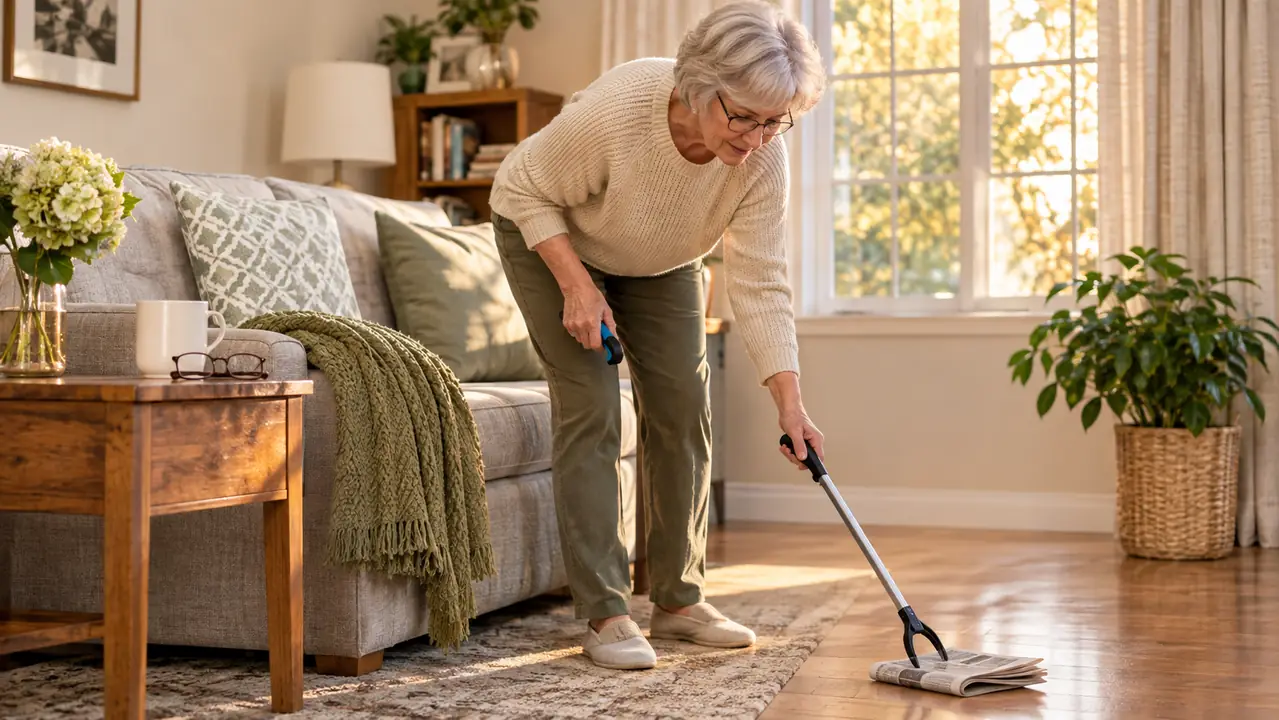
Gene dropped a nickel in the kitchen two winters ago and we both stood there looking at it. He has a weak right hip and balance that comes and goes. My left knee is a replacement I got about four years ago, at sixty-seven, after years of rec league softball wore it out. Neither one of us was going to bend down for a nickel. We left it there until our granddaughter came by on Saturday.
That is the part nobody warns you about. It is not the big obstacles. It is the coin that rolls under the stove, the mail that slides under the mat, the newspaper on the porch, the pill that bounces under the dresser. Things that used to take half a second now take a decision. Two months after my surgery, when bending was still hard, I bought a ZAYAD reacher grabber. It is 32 inches long, it folds, it weighs 8.6 ounces, and it hangs on a hook by my kitchen door. Three years and ten months later it is still the first thing I reach for.
I am not a doctor and I am not a physical therapist. Before you change how you bend, lift or reach, ask yours. Mine is Dana, and she is the one who told me to stop doing the deep knee bend with a twist, which was exactly how I had picked things up my whole life. What follows is how I actually use the reacher, step by step, plus the mistakes I made first.
The 8.6 Ounce Fix for Everything You Used to Bend For
A 32 inch grabber that folds, weighs less than a coffee cup, and reaches the floor, the back of a cabinet, and under the bed without a single knee bend.
Amazon Check Today's Price on Amazon →Step 1: Practice on something soft, standing still
The first thing I did with mine was go after a dime. That was a mistake. I was nervous, I pulled too early, and I knocked it across the floor. Start with something soft and forgiving. A dish towel. A sock. A folded napkin. Something that will not roll, will not break if you drop it, and does not matter if you miss twice. A sock is the perfect first target because it does not care how badly you do.
Stand still while you practice. Not walking, not leaning on a counter, both feet flat on the floor. Get used to the weight of the ZAYAD first, because 8.6 ounces does not sound like much until you are holding it out at arm's length. Hold it out, let it hang, bring it back. If your shoulder complains after ten seconds, that is worth mentioning to your physical therapist before you go any further.
Dana had me practice three days in a row on a towel before I was allowed to go after the mail. That sounds fussy. It was not. Monday I tried it six times and missed four. Tuesday I got the sock on the second try and then dropped it on the way up because I rushed the lift. Wednesday I did ten in a row without looking at my hand, and that is the whole skill right there. The looking is what pulls your neck down and your weight forward, and once you stop looking, the reach gets shorter and steadier without you doing anything else about it. I still do a towel first if the tool has been sitting out in the car for a week.
Step 2: Set your feet before you reach
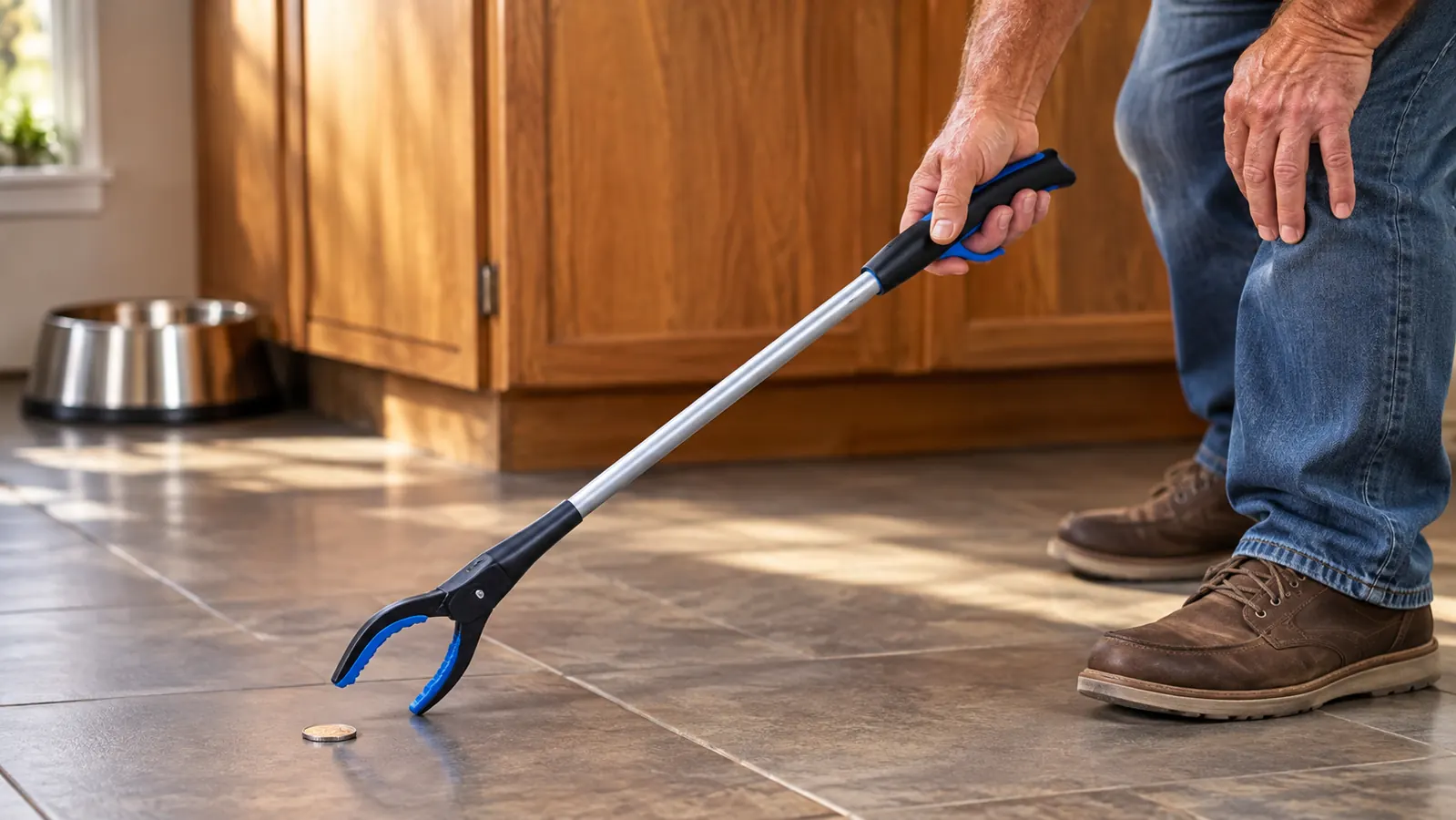
Stand square to the thing you are after, or as close to square as the room allows. Small step back. Feet about shoulder width. The 32 inch length means you do almost all the work from a standing position, which is the entire point, but only if your feet are already under you before the arm goes out. Reach first and step second is how people end up on the floor.
Never reach behind yourself. Never reach across your body to the far side of a chair. If the object is behind you, turn your whole body, then reach. Gene learned this one the hard way at the farmers market, going after a dropped receipt while he was already turning, and he wobbled. He did not fall. He came close enough that we both went quiet for a minute. The other spot that caught me was the three steps up to our front door. The newspaper lands on the second step most mornings, and my first instinct was to stand at the bottom and reach up and over. That is a lean, not a reach, and my knee told me so by Thursday. Now I go up the steps, put my hand on the railing, and pick it up from level ground.
Gene's balance is worse than mine, so his rule is different from mine. He holds the counter, a door frame or his cane in his left hand and works the reacher with his right. If there is nothing to hold, he does not do it. He waits for me, or he leaves it. Nobody has ever needed a dropped receipt badly enough to break a hip over it.
Step 3: Close the handle, then lift straight up
The pull is the part that takes a little feel. You reach out, settle the grabber end over the object, then pull the handle. Pull too fast and you will flick a coin across the room. Pull slowly and you can feel whether you actually have hold of it. Settle, pull, then give a small test lift before you commit, the way you would check a knot before trusting it with a suitcase.
Come at flat things from an angle. A coin lying flat on hardwood is the hardest thing in the house, because there is nothing to get under. My trick is to approach from the side, settle the end down until it touches, and pull. Envelopes are easier, and a folded newspaper is easier still because you can get the end under the fold. Trash is easiest of all, and trash is most of what I pick up. Nine times out of ten I am not rescuing anything valuable. I am saving myself a bend and a wince. The one thing I gave up on is a coin that has rolled flat under the radiator with about an inch of clearance. No grabber I have tried will get in there. I use a yardstick now, or I wait for Gene to feel ambitious.
Lift straight up, not toward you. Straight up first, then bring it in to your chest. If the thing slides out and drops, that is fine. Try again. Nothing I use this for is breakable or expensive, and I would like to keep it that way.
Step 4: Keep the load close and do not twist
Once you have got it, bring it to your chest before you turn. The reach out is one motion. The lift is a second. The turn is a third. Doing all three at once is how people hurt themselves with a tool that is supposed to be helping them. I still catch myself rushing this one when the phone is ringing.
I keep mine to light things. Coins, envelopes, mail, the newspaper, the TV remote, a sock, the pill that rolled under the dresser. That is what it is built for and it does those well. I do not trust it with anything heavy or breakable. No glass, no full mug, no jar. Gene tried a jar of pickles once and got about four inches off the floor before it slipped out and rolled under the radiator. We were finding pickles for a week. The pill was its own lesson. It went under the dresser on a Sunday morning before church and I had three minutes. I got it on the first try because I did not hurry and I did not try to do it from the doorway. I got close to the dresser with one hand on the bed frame, reached under, and lifted straight up. If I had tried it from across the room with one foot already out the door, I would have been late and sore instead of on time.
If something is heavy or awkward, the reacher is not the tool for it. Get down on one knee with a hand on something solid, or ask for help, or leave it until someone comes by. I have left things. It stings the pride a little. It is cheaper than the alternative, every time.
Step 5: Hang it where the drops happen
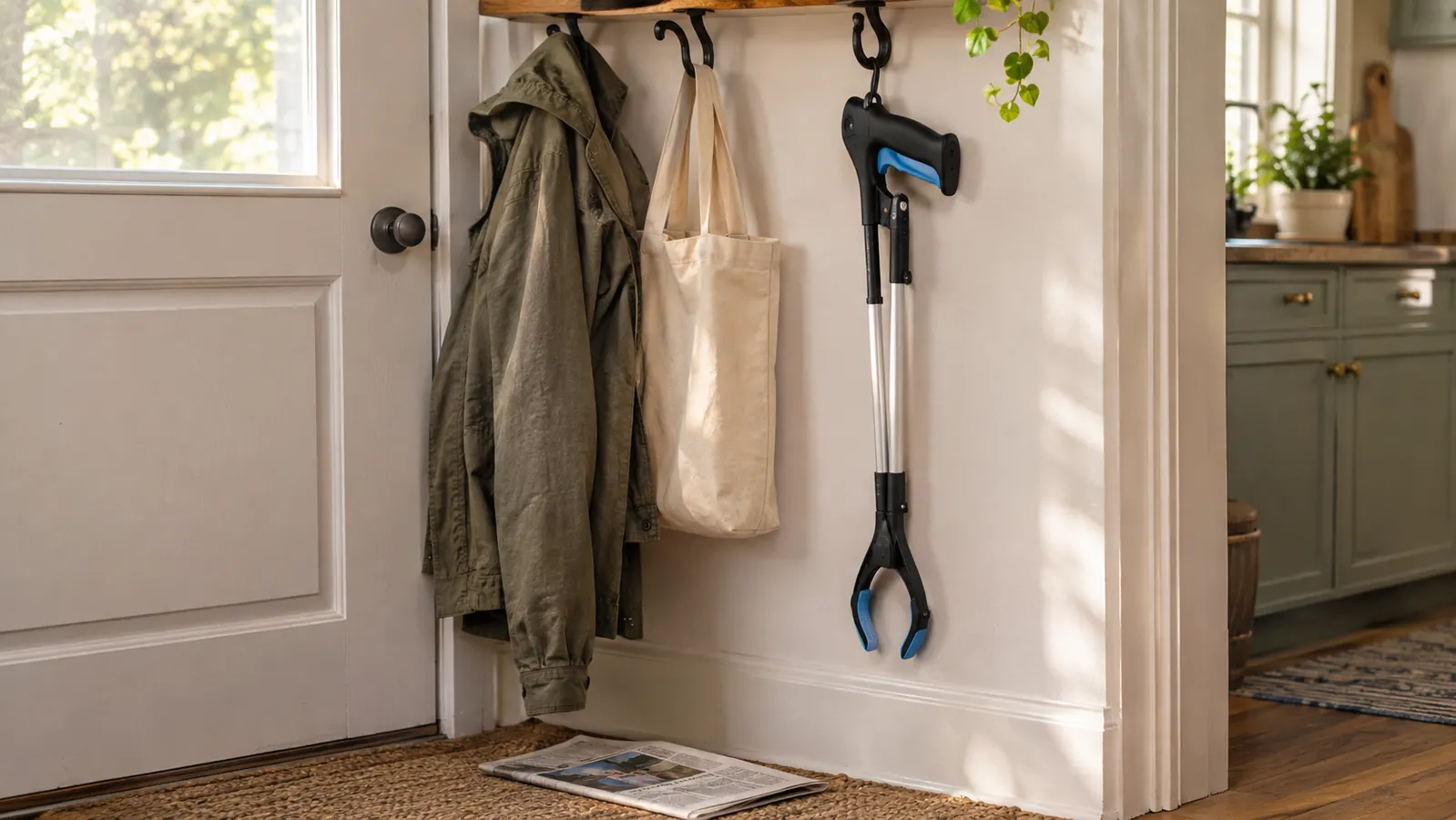
Mine lives on a hook by the kitchen door. Not in a drawer, not in the closet, not folded up in a bag in the garage. The whole value of the ZAYAD is that it is closer than bending, and if you have to walk to another room and open something to get it, you will bend instead. I know this because that is exactly what I did for the first month.
It folds, so it goes in the car with me. A folded tool in the door pocket has saved me in a parking lot more than once, and it tucks in behind the seat without taking up room. But when I get home, it goes back on the hook. That is the rule, and the rule is the whole system.
The other rule is about Gene. He borrows it and he does not always put it back. I have found it on the dining table, on the arm of the couch, and once in the garage on top of the rollator. So I ask him, out loud, where my reacher is. He is seventy-four. He puts it back now, mostly.
What Else Helps
A reacher handles the floor. It does not handle everything, and it is not a replacement for a walker or a cane on a hard day. What helped us more than any single tool was spreading the work around. The rollator lives in the garage for long outings. Gene's cane stands next to his chair so he does not have to reach for it. The car cane stays in the door pocket for getting out of the passenger seat in a church parking lot, which was its own small disaster for a while.
Small changes around the house did the rest. A basket by the front door for the mail, so it does not end up under the mat. A brighter bulb in the hallway, because half of what I dropped, I dropped because I could not see it. We put a lamp on the table by the front door too, and that one change cut down on the evening fumbling more than anything else on this list. Gene's reading glasses now live in the pocket on the bed bar instead of on the floor beside the bed, which is where they used to land every single night. Nothing is stored on the top shelf that I need more than once a week. I also stopped carrying more than one thing up the stairs at a time, which was a harder habit to break than it sounds.
And the biggest one, honestly, was the pride. It took me months to use a grabber in front of anyone but Gene. It took him longer to use a cane. If you are at that stage, I understand it, and I have nothing clever to say except that the day you stop noticing you are using it is the day it starts to be worth it.
It is not the big things that get you after a knee replacement. It is the nickel under the stove and the mail that slid under the mat.
Hang It by the Door and Stop Negotiating With the Floor
Thirty-two inches of reach, folded and out of the way until you need it, which is usually about four times before lunch. Ask your physical therapist first, then see what today's price looks like.
Amazon Check Today's Price on Amazon →