
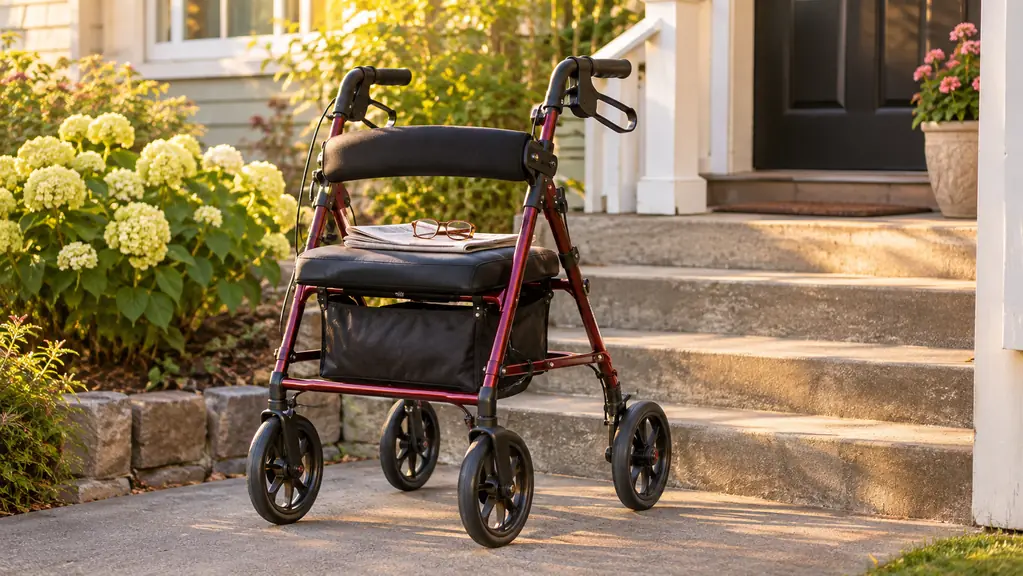
The week before my knee replacement, my physical therapist Dana sat me down and said four words I did not want to hear: you need a rollator. Not a cane. Not a walker with the little tennis balls on the feet. A four wheeled thing with a seat. I was 67, I had played rec league softball into my late fifties, and I had spent thirty years standing in front of a classroom of second graders with a pitch pipe in my hand. The idea of pushing a rollator into my own kitchen made my ears go hot.
I bought the Drive Medical Rollator Walker with Seat anyway, the week before surgery. Seven and a half inch wheels, steel frame, twenty pounds, a seat I could sit on, a back support that folds up and comes off, and a 350 pound weight capacity that told me it was not a toy. It arrived in a box the size of a small refrigerator, and I had the back support on backwards the first time I put it together. That was four years ago. It has been in my garage for most of that time, and I am still not sorry I bought it. But I have one real complaint, and my husband Gene has a whole separate set of opinions about it, and you should hear all of it before you spend anything. I am not a doctor or a therapist. Ask yours before you change anything.
The Quick Verdict
A steady, honest workhorse that got me through knee replacement recovery and now earns its keep on long outings. Heavy enough to be a nuisance in a car trunk, and that is the whole of my complaint.
Amazon Check Today's Price →The rollator I bought the week before knee surgery, and still own
Steel frame, 7.5 inch wheels, a seat that holds up under a real rest, and a 350 pound capacity. It is the one piece of mobility gear I never once regretted buying.
Amazon Check Today's Price on Amazon →How I've Used It
I used it every single day for the first three months after surgery. Every day. Down the hall to the bathroom at two in the morning, out to the mailbox, from the car into the church, around the block when Dana told me walking was the whole point.
The first week home is the part nobody prepares you for. I came home on a Thursday. Between Thursday and Sunday I made the trip from the recliner in the living room to the bathroom at the end of the hall roughly thirty times, and every one of those trips was the Drive Medical rollator, not the crutches. The handles sat exactly where my hands fell without me having to look down, which matters at two in the morning when you are half asleep and your knee is stiff as a board. I kept a small basket on the seat with my pills, my phone and a pencil so I did not have to carry anything in my hands, and that basket rode that seat for two solid months.
The seat is what made it different from the walker my mother had. When your knee is four weeks out of surgery and you have gone a quarter mile further than you meant to, you do not need a lecture about pacing yourself. You need to sit down. I sat down on that seat on the sidewalk in front of the Fowlers' house more than once and let my knee stop yelling at me, and then I got up and walked home.
By month four I was doing the neighborhood loop, about half a mile, with one rest on the seat. By month six I did not need it in the house anymore. The knee had healed and the rollator moved out to the garage, which is where it lives now, next to the recycling bins.
Then Gene got his turn. Fourteen months ago at the county fair, halfway around the livestock barn, his right hip gave out on him. He had been saying no to that rollator for months. I walked back to the car and got it and he used it the rest of the afternoon without a word of complaint, which from Gene is a speech. Now it goes to the fair and the farmers market and anywhere we will be on our feet for more than an hour. We reset the handle height between us, which takes about ten seconds, and then it is his turn.

What the Frame and Wheels Actually Do
The Drive Medical frame is alloy steel, and it feels like it. Twenty pounds of it. That weight is why the thing does not skitter when you lean on it, and it is also the reason I curse every time I lift it into the trunk of our sedan.
The 7.5 inch wheels are the part I underrated. Our sidewalk is not smooth. It is Dayton city concrete with roots pushing it up in three places, and there is a lip where the concrete meets the street that has tripped better women than me. The wheels roll over that lip without stopping dead, which is not something I can say about the small hard wheels on the borrowed walker I used at the hospital.
The height adjustment lever sets the handles where you want them, and the top of the range is 35 inches. I am 5 foot 4 and Gene is 5 foot 10, and the two of us share this thing, so that lever gets used more than anything else on it. The back support folds up and lifts off completely. I took it off for the first month because it was in my way getting up out of the seat, and I put it back on when Gene started using it because he likes something behind him. Both of us got what we wanted out of the same piece of hardware.
Two practical things I did not expect to care about. The first is the brakes. There are hand brakes on both grips that you squeeze to slow it, and a lock position that holds the wheels so the thing does not roll away from you while you are standing up out of the seat. I use that lock every single time I get up, without thinking about it anymore. The second is width. The frame is 21.5 inches across at the widest point and our bathroom door is 28 inches, so it fits, but with about three inches of room on each side. I learned to take it through square instead of at an angle. The vestibule door at church is narrower than that and I leave it outside on Sundays and use the pew backs instead.
It folds. Not flat enough to hide behind a couch, but flat enough to live in a garage corner or stand in the back of a car. The seat wipes clean. I have put a wet grocery bag on it, a coffee cup, and once, for twenty minutes, my choir folder while I dug for my keys.
Twenty pounds is why it does not skitter when you lean on it. Twenty pounds is also why I make a small noise every time I lift it into the trunk.
The One Thing I Genuinely Do Not Like
It is heavy to lift. Twenty pounds does not sound like much until you are doing it at an angle into a car trunk with a knee that is still deciding whether it wants to cooperate. In the first three months I did not lift it at all. Gene did, or I left it in the car and skipped the trip. Now that it lives in the garage, it comes out for the fair and the market and goes back in, and I feel every one of those twenty pounds at the end of a long day.
I have one specific memory that sums it up. A Tuesday last October, we came back from the grocery with the trunk already half full, and I stood there holding that rollator off the ground for what felt like a full minute trying to work out how to get it in without twisting my knee. Gene ended up doing it. That is the entire complaint, in one picture.
I have thought about a lighter one. I have looked at them online. But every lighter rollator I have looked at trades away some of the steadiness, and steadiness is the entire reason I am using it instead of a cane. At 5 foot 4 and 71 years old with a steel knee, I will take the weight and complain about it.
The other small thing: it is not a chair. The seat is for resting, not for sitting through a two hour concert. Twenty minutes is fine. Forty minutes and you will want to be somewhere better.
What Four Years Did to It
Nothing dramatic. The tires on those 7.5 inch wheels show wear on the tread but have not needed replacing. The folding mechanism still clicks into place and still holds. The seat pad has a faint crease where I always sit and no tears. The brake handles work the same as the day I unboxed it. Nothing has come loose that I have had to tighten more than once.
The one bit of maintenance I have done is a five minute job. About two years in, the folding latch on the left side started to feel a little soft. Not loose, just soft. I put a quarter turn on the bolt with an Allen wrench, checked that the frame still locked open with a solid click, and it has been fine ever since. I wipe the Drive Medical frame down with a damp rag a couple of times a year, mostly to get the winter salt off the lower legs, because Dayton salts the side streets like it is going out of business and that salt does not do steel any favors.
It has been rained on. It has been in a hot garage every summer for four years. It has been leaned on by a man who is 5 foot 10 and not gentle. The limited lifetime warranty is a nice thing to have in the drawer, but I have never had cause to use it, and after four years that is the sort of sentence I like to be able to write.

Things I Wish Someone Had Told Me
Set the height before you need it, not after. Dana had me stand with my arms relaxed at my sides and set the grips at the crease of my wrist. If you have to reach down or lift your shoulders, it is wrong, and your back will tell you so in about a week.
Use the brakes going downhill. It has brakes. They are not decorative. Our street slopes down toward the corner and I learned this the hard way on day nine.
Measure the two doors you use most before the box arrives. Not the hallway. The doors. Ours is 28 inches and the rollator is 21.5 inches wide, so it goes through, but I have a friend in Oakwood whose bathroom door is 24 inches and hers does not go in at all. She parks it in the hall and holds the doorframe instead. That is a thing you want to know in advance, not at two in the morning.
Measure your trunk opening, too, before you buy anything with wheels. Our sedan swallows it fine, but I have watched a neighbor wrestle a rollator into an SUV and lose.
And let someone else lift it for the first month. Pride is expensive and it does not heal a surgical site.
What I Liked
- Steady under a real lean, thanks to the steel frame and 20 pound weight
- 7.5 inch wheels roll over sidewalk lips and root heaves that stop smaller wheels cold
- The seat is genuinely useful, not a token cushion
- Height adjustment lever lets two people of different heights share it
- Back support folds up and comes off entirely
- Four years of use with no part failures and no repairs
Where It Falls Short
- Twenty pounds is a real lift into a car trunk
- Not comfortable to sit on for more than about twenty minutes
- Folds down but not small enough to tuck out of sight
- The weight that makes it steady is the same weight that makes it a chore
Who This Is For
Someone recovering from a knee or hip replacement who has been told to walk and has also been told not to overdo it. The seat is the answer to that contradiction. You walk until you should stop, and then you stop, right there, without needing a bench. If you are the sort of person who will push past the point where you should sit, this removes the excuse.
Someone whose balance has gotten unreliable on long outings but who is not ready for a walker. Gene is exactly this person. He uses a cane daily and does not need more than that around the house, but a fairground for four hours is a different job and he knows it now.
And couples who share one piece of equipment. The height lever means you do not have to buy two. If you are within a few inches of each other, the Drive Medical rollator works for both of you, and it works without either person feeling like they are using the other one's gear.
Who Should Skip It
If you need to get it in and out of a car several times a day by yourself, look at a lighter model first. Twenty pounds, repeated four times a day, at an awkward angle, is how people hurt their shoulders. Be honest about that math before you buy.
If what you actually need is help getting up out of a chair, this is the wrong tool. That is what a bed assist bar or a firm chair with arms is for. A rollator is for walking and resting, not for standing up from a seated position in your living room. I have watched people buy one for that job and get frustrated with it inside a week.
And if your doctor or therapist has told you to use a specific type of walker for a specific reason, listen to them and not to me. I am a retired music teacher with a steel knee and a strong opinion. Dana is the one with the training.
Four years in my garage, and it still goes to the county fair
Steel frame, 7.5 inch wheels, a seat that has held me up on a sidewalk more times than I can count, and a 350 pound capacity. If your therapist is telling you what mine told me, the Drive Medical rollator is the one to look at.
Amazon Check Today's Price on Amazon →