

Gene is 74 and his right hip quits on him without warning. It might carry him into a restaurant fine and then refuse to push him back out of the chair forty minutes later. For about eleven months he refused every cane I brought home. He is not a stubborn man about most things. He was stubborn about that one.
What finally did it was our anniversary dinner. He had borrowed a plain cane from the church closet, the kind with a thin tip and no opinion about where it lands. He set it against the edge of the table, it slid off, and it went down in the middle of the dining room. A waiter had to fish it out from under the next table while we all pretended not to watch. On the drive home Gene said, quietly, that he was not doing that again. The next week I went looking for a cane that stands up on its own, and that is how the HurryCane Freedom Edition came into this house two years ago. It is his cane. I am the one who ordered it, set the height, and has watched him use it every day since.
The Quick Verdict
It stands up when he lets go, and after two years that is still the whole reason it lives beside his chair. The wide base catches on thresholds and it is bulkier folded than a plain cane. Neither has been enough to send it back to the closet.
Amazon Check Today's Price →The cane that is still standing when he lets go of it
One borrowed cane slid off a restaurant table and that was the end of the argument. Two years later this one has not fallen once. It stands on its own beside his chair, in the pew, and at the kitchen counter while he reaches for his coffee.
Amazon Check Today's Price on Amazon →How I've Used It
Strictly speaking I have not used it. Gene has. But I bought it, I set it, and I have watched him use it every day for two years, so I can give you an honest account of what it does and what it does not. I also know what a plain cane feels like, because the hospital sent me home with one after my knee replacement four years ago and I used it for a few weeks before Dana pointed me toward a rollator instead. A plain cane is fine while your hand is on it. The trouble is all the hours you are not holding it.
The HurryCane adjusts from 30.5 inches to 37.5 inches. Gene is 5 foot 10, so he sits near the top of that range. I set it the way Dana showed him, with the handle landing at the crease of his wrist while his arm hangs at his side, and setting it took one try. It has not slipped in two years. If you are closer to my 5 foot 4, or taller than Gene, the range still covers you, which is more than I can say for the cane the church closet loaned us.
He carries it in his left hand, opposite the weak right hip. Dana was firm about that, and I understand why now. When he tried it in his right hand it felt natural for about ten steps and then he was leaning on it instead of walking with it, hunched to that side like a man hauling a heavy suitcase. In the left hand it just walks with him. Two years in, it looks like part of how he moves rather than something he is managing.
What the HurryCane Actually Is
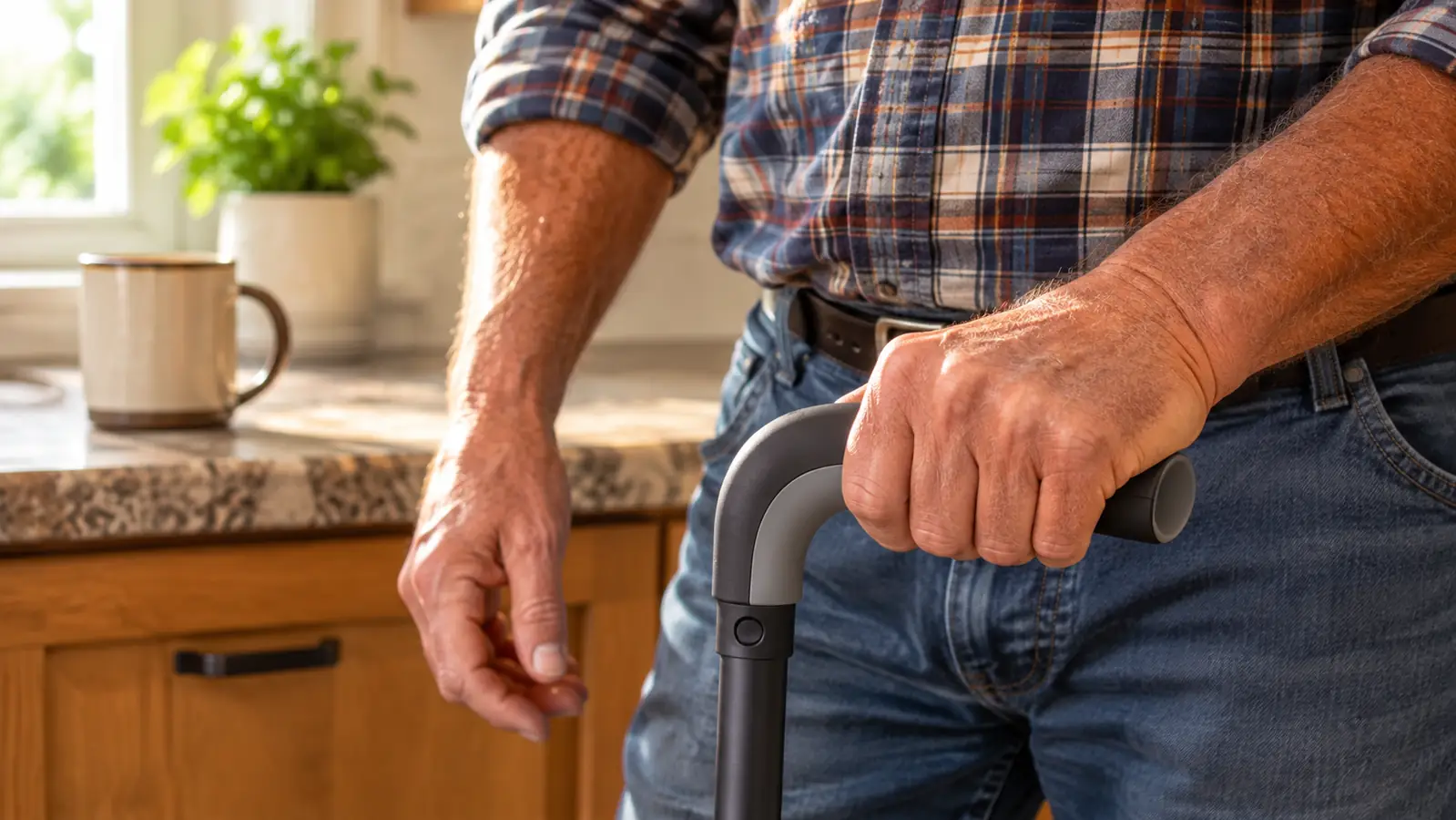
Strip away the box copy and it is an aluminum cane that weighs 16 ounces, with a rubber handle and a resin base, backed by a limited lifetime warranty. The shaft folds, and folded it measures 13.7 inches, short enough to sit in the tote bag we take to church or behind the passenger seat of the sedan. The handle is a T shape rather than the crook most people picture when they hear the word cane. That matters more than I expected. The T sits flat in the palm instead of hanging off the wrist, and Gene says his hand does not ache after a long morning the way it did with the borrowed one.
The feature that sold me is the base. It stands on its own. That sounds like a small thing until you have watched someone try to park a cane against a restaurant table and lose it to the floor. Gene set it down beside his chair the first week and it stayed there. It has stayed there ever since.
What it is not is a walker, a rollator, or a substitute for either. It is one point of support for one side of the body. A cane does not carry your weight, it gives you something to lean on while your own leg does the work. That distinction took me a while to understand, because when you are the spouse watching from the doorway, everything that keeps him upright looks like the same category of thing. It is not.
When Gene has a long day ahead of him, the county fair, the farmers market, an afternoon on his feet, he takes the rollator out of the garage and leaves the cane by his chair. He worked that out himself after one bad afternoon. The cane is for the ordinary day: the kitchen, the hallway, the church pew, the walk from the car into the doctor's office. It is not a plan for a whole day out.
The Standing Trick, Two Years Later
I expected the novelty to wear off. Two years on, it has not. The cane stands next to his chair in the living room, and when he gets up he does not have to bend for it, or ask me to hand it to him, or feel around on the floor with his foot. At 74, with a hip that is not reliable, not bending for something on the floor is worth more than the cane costs.
The same thing happens at church. It stands beside the pew instead of rolling into the aisle during the sermon. It stands at the kitchen counter while he reaches for the coffee. It stands in the bathroom doorway while he hangs up a towel. Small moments, dozens of them a day, where a plain cane would have gone down and he would have had to go get it.
The base is wide, and wide has a cost. It catches on thresholds. It catches on the metal strip between the kitchen and the garage. It catches on the edge of the area rug in the hall if he does not lift it enough. Not often enough that he has complained about it, and it has never once dumped him, but I have watched him lift it over the door sill rather than drag it through. If your house is full of raised thresholds and tight doorways, that is a real consideration and I would not pretend otherwise.
The one place it does not help is the car. A cane is for walking. It is not for getting up out of a low passenger seat, and it is not for standing up from a chair that sits too low. Those are different jobs and we had to solve them separately. Gene has a grab handle that clicks into the car door frame now, and it has nothing to do with the cane.
What Two Years of Daily Use Has Shown
The handle has held up. The rubber is not slick and it has not cracked, which is the first thing I check on anything he grips. The folding joint still locks solidly and does not rattle when he walks, and I had assumed it would after a year of being carried in and out of a car. The tip shows wear, which is normal for anything that touches sidewalk every day, and it is the part I keep an eye on.
Gene does not fold it much. He folds it when we take it in the car and he wants it out of the way, and folded it is 13.7 inches, which fits in the church tote. But folded it is still noticeably bulkier than a plain cane and it does not disappear into a bag the way the plain ones do. If portability is your main concern and standing up is not, a plain folding cane is the smaller object. Full stop.
What has surprised me is how little he talks about it. He complained about the borrowed cane for a week. He has not complained about this one in two years, and he is a man who will tell you if a restaurant chair sits an inch too low. I take that as the review.
The HurryCane has one job and it does it. It keeps him from bending down, it keeps him from asking, and it keeps him off the floor. That is the whole thing.
The Things I Wish I Had Known Sooner
I wish I had known that the cane is the easy part and the low chairs are the hard part. We spent a year thinking Gene needed better support for walking, and what he actually needed was a way to get up out of a seat without me pulling on his arm. The cane solved the walking. It did nothing for the seated problem, and I would have bought the car door handle and the bed bar a year earlier if I had understood that.
I wish I had known to set the height with someone who knows how. I had it an inch too low for the first week because I measured against his hip instead of his wrist. An inch is not much until you are walking on it all day. Dana fixed it in about ten seconds at a follow up and I felt foolish, and it is the first thing I tell anyone who asks me about a cane now.
And I wish I had known not to argue about it. For eleven months I brought canes home and Gene ignored them, and what actually moved him was not an argument, it was one bad evening at a restaurant. If your husband is refusing, the cane is not the problem. Wait for the bad evening, keep the catalog open, and then come back with the one that stands by itself, because it is the one he will not have a reason to leave on a table.
What I Liked
- Stands on its own, so Gene never has to ask anyone to pick it up
- 16 ounces, and it folds to 13.7 inches for the car or a bag
- Adjusts from 30.5 inches to 37.5 inches and stays where you set it
- Rubber handle with a T shape that sits flat in the palm
- Limited lifetime warranty on an aluminum shaft
Where It Falls Short
- The wide base catches on thresholds, door sills and rug edges
- Folded, it is still bulkier than a plain folding cane
- It is one point of support, so long days still need a rollator
- Two years of sidewalk has worn the tip
Two years, one cane, and he has not had to ask a waiter to fish it off a restaurant floor since.
Who This Is For
Someone who needs one point of support and has the strength and balance to walk with one point of support. Gene is that person. He walks slowly, he watches the ground, and he does not need a seat and he does not need four wheels. If that describes you, or the person you are shopping for, this is a good cane and it will last.
It is also for the person who is refusing a cane. That is the honest reason I would hand this recommendation to a friend. The standing feature removes the small daily humiliations of using a cane, the sliding, the bending, the asking, and those humiliations are what the refusal is really about. Gene did not want to be a man whose cane is on the floor. This one is not on the floor.
Who Should Skip It
If you need a seat, or you tire after a few hundred feet, this is not enough and no cane would be. That is a rollator conversation. A cane gives you something to lean on. It does not carry you, it does not rest you, and it does not get you through a whole afternoon at a fair. Gene takes the rollator for those days and so would you.
If your house is narrow, or your main concern is something that disappears into a bag, skip it. The base is wide by design and it will catch on door sills and rug edges, and folded it is bigger than a plain folding cane. Those are the tradeoffs and I would rather tell you than have you find out in your hallway. A plain cane is a perfectly good object. This one is a plain cane that stands up, and you should buy it only if standing up is the thing you need.
It has stood by his chair for two years
16 ounces, folds to 13.7 inches, adjusts from 30.5 to 37.5 inches, limited lifetime warranty. It will not replace a walker on a long day. It will keep a stubborn man from leaving his cane on a restaurant floor.
Amazon Check Today's Price on Amazon →