
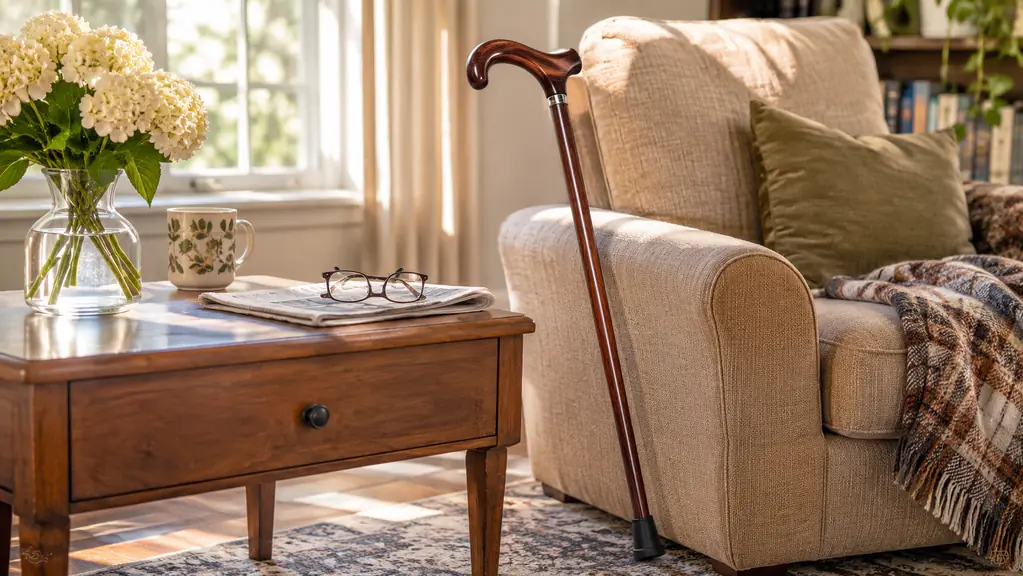
Here is the short answer, the one I wish somebody had handed me two years ago. If the person using the cane has to set it down, lean it against something, or pick it back up more than a couple of times a day, the HurryCane Freedom Edition is the better tool. If the cane only comes out for a short, planned walk with somebody nearby, a standard folding cane does that job and asks nothing of you in return.
We have owned both in this house. The HurryCane belongs to my husband Gene, who is 74 and has a weak right hip and balance he does not trust. The plain folding cane was mine, briefly, four years ago after my left knee replacement. I used it for a few weeks and then it went in the hall closet, and I have been thinking about the difference between those two canes ever since.
| HurryCane Freedom Edition | Standard folding cane | |
|---|---|---|
| Stands up on its own | Yes. The wide base holds it upright beside a chair or a table, so it is there when you reach back for it | No. Let go of it and it goes to the floor |
| Folded length | 13.7 inches | Also folds, usually into four sections on an elastic cord |
| Weight | 16 ounces | Lighter. A single-tip aluminum cane with less going on at the bottom weighs less |
| Handle | Rubber T handle, a bar you close your whole hand around | Often a crook handle that can hang over the forearm and free the hand for a moment |
| Height range | 30.5 to 37.5 inches | Adjustable too, but the range depends on the model, so check it before you buy |
| Learning curve | A few days. The wide base catches on thresholds and rug edges until you learn to lift it slightly | None. You pick it up and walk |
| Hands-free moments | You can let go to open a door, pay a cashier, or shake a hand | You have to lean it somewhere or bend down for it |
| Warranty | Limited lifetime | Rarely more than a short manufacturer warranty, and often none at all |
| Best for | Someone who is up and down all day and needs the cane to be where they left it | Short planned walks and a cane that has to disappear into a bag |
How We Ended Up With Both
When I came home from the hospital, they sent me with a folding cane. Aluminum, four sections, an elastic cord running down the middle so it snapped together when you shook it out. I needed it for a few weeks while the new knee decided whether it was going to cooperate. It did the job. It also spent a good part of every day on the floor, because the moment I let go of it, over it went.
Gene is a different story. He would not carry a cane. Not for the hip, not for the balance, not for the walk across a parking lot. We had that conversation for the better part of a year and I lost it every single time. Then we went out for our anniversary dinner, and a cane the restaurant had loaned him slid off the edge of the table and hit the floor in the middle of the dining room. He had to ask the waiter to pick it up. He said, never again, and I knew exactly what he meant.
What changed his mind was not a lecture from me. It was the fact that this one stands up on its own. I found the HurryCane looking for exactly that, ordered it the next week, and set it beside his chair without saying one word about it. He carries it in his left hand, opposite the weak hip, which is how Dana showed him. He has used it every day for two years and it has not been in the closet once.
I did look at a few other things first. A quad cane with four feet, which is steadier than either of these but is a piece of furniture you carry from room to room. A rollator, which we already had in the garage and which he was never going to take into a restaurant. And a plain cane with a bigger tip, which does not solve anything, because the problem was never the tip. The problem was that it fell over.
Where HurryCane Wins
The entire argument lives in that base. A cane that stands by itself is a cane you will actually pick up, because you are not gambling on whether it will still be there when you turn back around. Gene sets it beside his chair and it waits for him. He sets it against the diner table while he gets his wallet out and it stays put. At church he can let go of it to shake a hand and reach back down without looking. My plain cane gave me none of that. I spent those weeks picking a cane up off the floor.
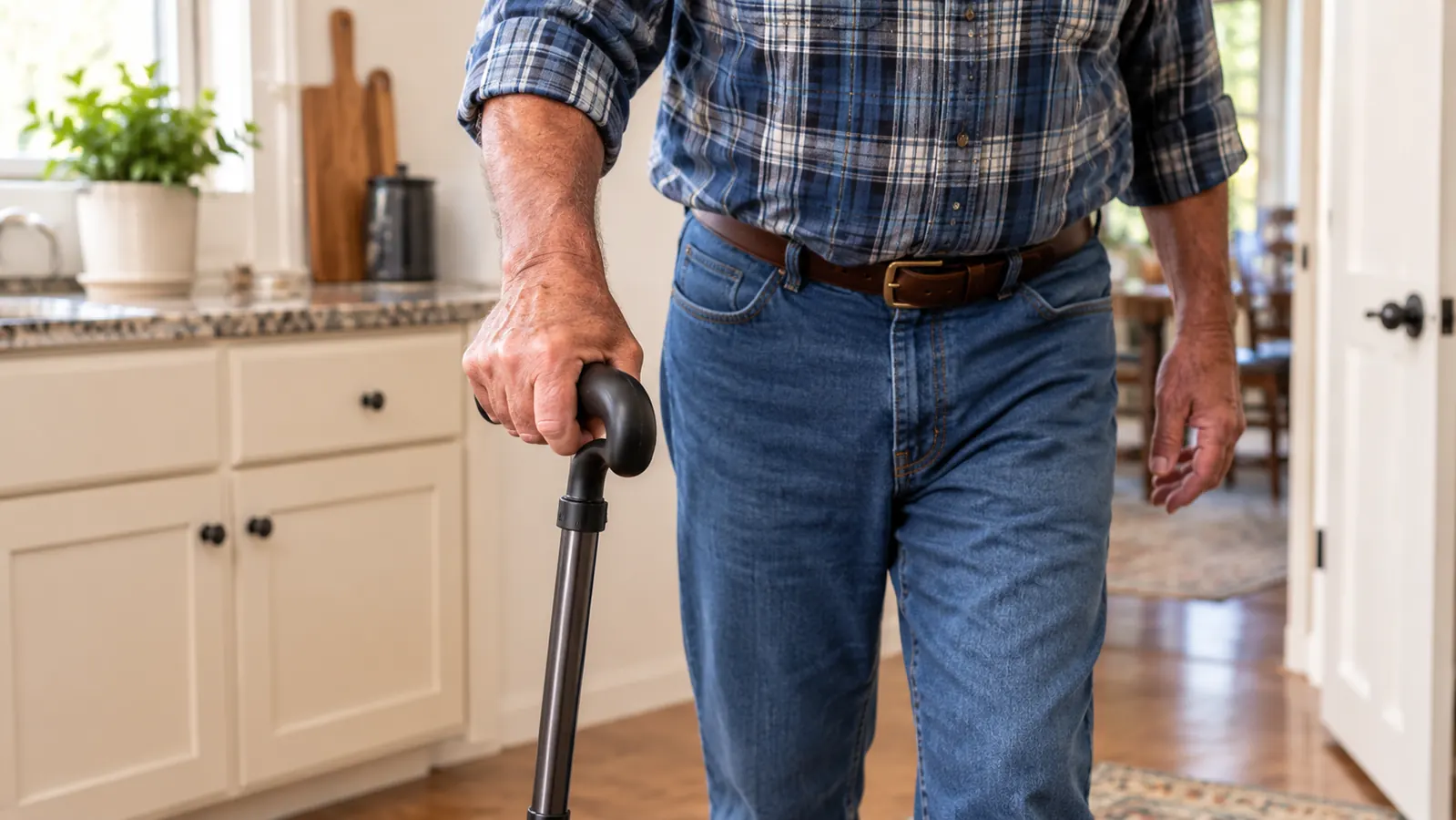
The second thing is the range. It adjusts from 30.5 to 37.5 inches, which covers Gene at 5 foot 10 with room on both ends. When our granddaughter visits and wants to walk him to the corner, she can drop it two notches and put it back before he notices. The T handle gives him a full hand to wrap around instead of a hook to balance on, and he says that feels steadier on the days his hip is talking to him. It is 16 ounces of aluminum and it has held up to two years of being grabbed forty times a day.
The other thing I did not expect is that it gets used. That sounds like a small thing to put in a comparison. It is not small at all. We had a cane in this house for a year that lived in the closet behind the coats because Gene would not be seen with it, and a cane in the closet helps nobody. This one is in the room with him. He reaches for it without thinking about it, and that is worth more than any line on a spec sheet.
Where a Standard Folding Cane Wins
Now the honest part. The wide base catches. It catches on the threshold at the front door, on the metal strip between the kitchen and the sunroom, and on the edge of the rug in the hallway. Gene has learned to lift it a little as he crosses, and it took him maybe a week to stop noticing, but he did have to learn it. My plain cane had one small tip and it never caught on anything. It went where I pointed it.
The plain cane is also lighter and it disappears better. Put a folded cane of that kind next to Gene's and the difference in bulk is obvious. The hospital cane slid into my tote bag and I forgot it was in there. His folds to 13.7 inches, which is respectable, but you feel it in a bag. And the handle on mine was a crook, so I could hang it over my forearm when I needed both hands for the church bulletin or a plate of food. You cannot hang a T handle on your arm.
One more thing, and it is the thing that matters most. Neither of these is a walker. On a long day, the county fair or the farmers market, Gene takes the rollator and the cane stays in the car. No cane, however stable its base, is going to hold somebody up for two hours of standing in a crowd. If that is what you need, you need wheels and a seat, and no amount of clever design at the bottom of a cane changes that.

What Two Years of Daily Use Has Looked Like
It sits beside his chair in the living room. It goes to church on Sunday and stands at the end of the pew while we sing, and it is upright when the last hymn ends. It rides in the back seat of the sedan and comes out at the hardware store and the pharmacy. The rubber handle has not cracked and the base has not worn through. For a thing that gets grabbed dozens of times a day, that is what I actually wanted to know and could not find out from a listing.
The fold joint is the part I watch. Fold and unfold a cane several times a day for two years and something either loosens or it does not. This one has not. It still folds down flat, still locks open, and still stands. Gene is not gentle with it. He drops it into the back seat, he leans on it getting out of the car, and he has knocked it off the porch twice. It has taken all of that without developing a wobble.
What I would tell you is that this cane solved a pride problem more than a balance problem. Gene did not need to be convinced he needed help. He has known that for years. He needed a cane that did not make him feel like a man who needs a cane, and a cane that stays standing in the middle of a restaurant does not. That was the whole door, and once it opened he started using it properly.
The one thing I cannot tell you about is ice. We are in Dayton, the sidewalks get bad in January, and Gene stays inside when they do. If you are shopping for a cane to get you through winter walking, ask somebody who has actually done it, because I have not and I am not going to guess at it for you.
A cane you can let go of is a cane you will actually use. That sounds like a small thing until you have watched somebody refuse one for a year.
The Cane That Was Still Standing When He Turned Back Around
It folds to 13.7 inches, adjusts from 30.5 to 37.5 inches, weighs 16 ounces, and stands on its own so it is there when you reach for it. Gene has carried his every day for two years.
Amazon Check Today's Price on Amazon →Who Should Buy Which
Buy the HurryCane if the person using it is up and down all day. Somebody who moves between a chair, a kitchen counter, a bathroom, and a front porch, who sets the cane down to use both hands and reaches back for it a moment later. Buy it if you have a refuser in the house, because standing on its own is the argument that finally worked on mine and I had tried every other one. Buy it if you want a single cane that covers indoors and out. It is not for somebody who needs two hours of standing support, and it is not for somebody who cannot manage lifting the base slightly over a threshold.
Buy a standard folding cane if the walking is short and planned. The trip from the car to the church door. The aisle at the grocery store with a cart right there. If the cane lives in a bag and comes out four times a week, the simpler tool is fine, and the wide base is just one more thing to think about on the way to the mailbox. And if a plain cane is what your physical therapist handed you and it is working, keep it. There is no prize for owning the better gadget.
Whichever way you go, ask before you change anything. I am not a doctor, a nurse, or a physical therapist, and I am not going to pretend otherwise for the sake of a paragraph. Dana is the one who told Gene which hand to carry it in and how high to set it, and that made more difference than the cane itself did. Get the height right and have somebody who does this for a living look at your grip and your gait. The cane is a tool. It is not the plan.
Get the Height Right and Let It Stand There Until You Need It
The Freedom Edition adjusts from 30.5 to 37.5 inches and folds to 13.7 inches. Set it at the right notch for your height, leave it beside your chair, and stop bending down for it.
Amazon Check Today's Price on Amazon →