
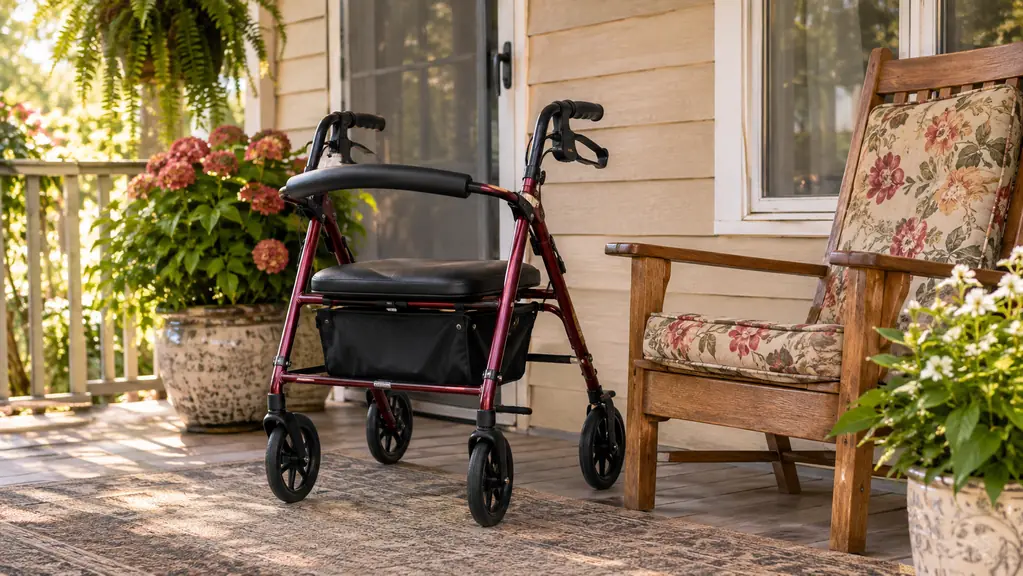
For two years after my left knee replacement, I measured every walk by how far I could get before I needed to sit down. Our block has one bench, at the corner. That bench decided my mornings. If I could not reach it, I did not go. What changed things was a Drive Medical rollator, bought four years ago the week before my surgery, on the advice of Dana, my physical therapist. The seat is the reason I kept it.
I am not a doctor, a nurse, or a therapist. I am 71, I taught elementary music for 30 years, and I had a knee replaced at 67. I ask Dana before I try anything new and I would tell you to ask yours. What I can offer is firsthand: four years of walking with a rollator, and a husband named Gene, 74, who now uses the same one on long outings. Here are ten reasons it earns its space in the garage.
The seat is the reason I bought it, and the reason I kept it
The Drive Medical rollator has a steel frame, 7.5 inch wheels, a 350 pound weight capacity, and a back support that folds up and comes off. Mine has been in the garage for four years and it still does the job.
Amazon Check Today's Price on Amazon →There is somewhere to sit when your knee says stop
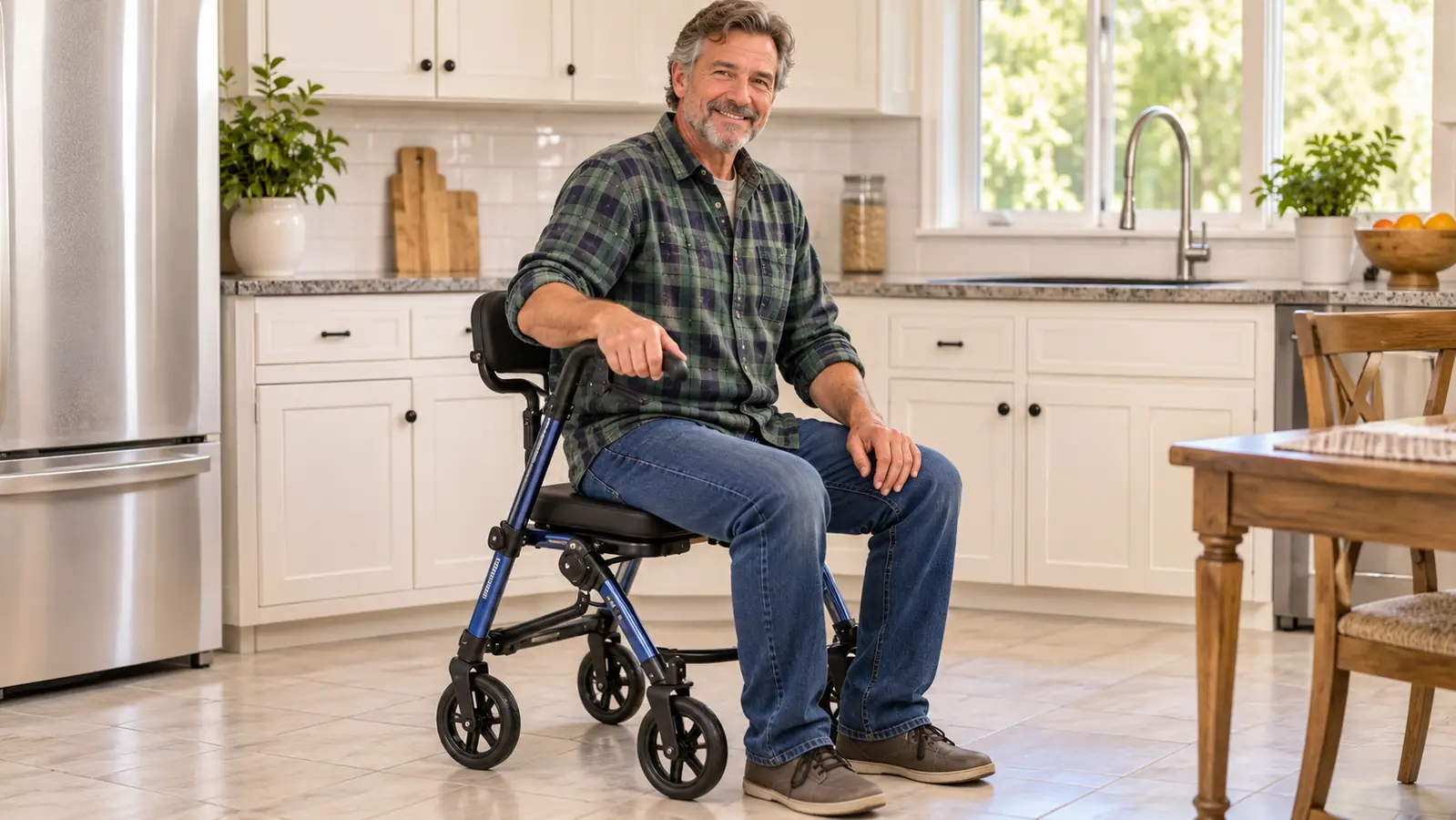
One bench on a whole block is not enough, and most neighborhoods are worse than ours. The rollator carries its own seat, so the bench stops being the thing that decides. When my knee started talking on the way back from the mailbox, I sat down on the sidewalk for a minute and then finished the walk. Nobody had to come get me and I did not have to turn around early.
You stop counting benches before you leave the house
After the surgery I got into the habit of counting benches before I walked out the door. It is a strange thing to do and I did not notice I was doing it until my daughter pointed it out. Once the seat is under you, the counting stops. You look at the sidewalk instead of the furniture. That sounds like a small thing. It changed how far I was willing to go on a Tuesday with nothing on the schedule.
A rest costs you a minute instead of a whole trip
The old version of a rest was going home. Turn around, walk back, take the three steps up to the front door, sit on the couch, and lose the rest of the morning to the couch. Now a rest is: sit down, breathe, watch the birds, stand up. A minute, maybe two, then off you go. Gene noticed it on his first long walk with the Drive Medical rollator. His word for it was that it felt less like a defeat and more like waiting at a traffic light.
It steadies you on the days your balance is off
The seat gets the attention but the walking part matters just as much. Both hands go on the grips, the frame is alloy steel, and the manufacturer rates it to 350 pounds. On a bad knee day I lean on it more than I stand on it and it holds without a wobble. Dana told me to keep my hands on the grips and not to carry anything in them. That was hard advice. I still catch myself steering one-handed with a coffee cup.
It gave me back the neighborhood loop
The loop around our block is about half a mile. I know because I looked it up after the surgery, when I was trying to work out what a reasonable target even was. I got back to walking it in month four, with one stop on the seat about halfway. Before the rollator I had given that loop up entirely. I want to be careful here. Knees are not the same and neighborhoods are not either, and I am only telling you what mine did.

Gene can finish a long day out instead of half of one
Gene is 5 foot 10 and his right hip is the weak one. He said no to every aid I offered for the better part of a year. Then at the county fair, halfway around the animal barns, his hip gave out and he sat down on a curb. I went back to the car for the rollator. He has taken it to the fair and the farmers market ever since. What he said afterward was that he got to see the whole thing instead of half of it.
One piece of equipment covers walking and resting
There is a version of this where you buy a walker and a separate folding stool and then carry the stool. That is two things to remember, two things in the trunk of the sedan, and one thing you will leave sitting at home. The rollator does both jobs in one frame. That is the whole idea. It is also why it lives by the garage door instead of in a closet, because if a thing is a hassle to get out, you will not get it out.
The handle height resets between two people
Gene is 5 foot 10 and I am 5 foot 4. There is a height adjustment lever, and the manufacturer lists a maximum height of 35 inches and a minimum height recommendation of 59 inches for the person using it. Gene sets it taller and I put it back where I want it. It takes a few seconds and it matters. A handle that sits too low has you hunched over, and a handle that sits too high will not steady you.
It gets you out of the house on a day you would otherwise skip
There are February mornings when the only reason I go anywhere is that the rollator is already by the door and I know I can sit down if I need to. That is a low bar for a walk and it has produced a lot of walks. Church on Sunday is the one I care about. I sing alto, and standing through a long rehearsal is how I measure the knee. The walk out to the car afterward used to be the worst part of the morning. Now it is just a walk.
It folds against the garage wall until you need it
Four years on, I do not use it around the house anymore. It sits folded in the garage and comes out for long outings, for the fair, for the farmers market. The back support folds up and lifts off, and the frame stands flat against the wall. The honest complaint is weight. It is 20 pounds, and lifting it into the trunk of our sedan is the one part of owning it that I still do not like.
What I'd Skip
Here is what I would skip, and I would say it out loud if we were standing in the same aisle. I would skip buying a second walker for the other person in the house. Gene and I share the one machine and reset the handle between us, and a second one would only be another 20 pounds to move. I would also skip the idea that the seat is a chair. It is a place to rest for a minute or two, not a place to spend an afternoon. If sitting for a long stretch is the real goal, a proper chair in the shade is the better tool.
I would skip the notion that this replaces a cane for short trips. Gene's cane is what he carries to the mailbox and it does that job well. The rollator comes out when the day is long. It would also be a poor fit for anyone who cannot lift 20 pounds in and out of a trunk, or whose house has a narrow hallway it has to get through. Measure first. I measured wrong the first time and had to rethink where it lives.
And I would skip any comparison I have not earned. I have never owned the Medline rollator, so I cannot tell you how the two stack up against each other. I looked at it the way I looked at everything, and that is all I can honestly report. One more thing I would skip: starting any of this without asking your own physical therapist. I am not a doctor and I am not a therapist. What worked for a 71 year old retired music teacher in Dayton is not a prescription for anybody else.
A rest used to mean going home. Now it means one minute on the seat, and then you keep going.
If you are still counting benches, this is the place to start
It is the same Drive Medical rollator I bought four years ago, heavy enough to hold you and simple enough to fold into the garage. Ask your physical therapist first, then look at the numbers yourself.
Amazon Check Today's Price on Amazon →