
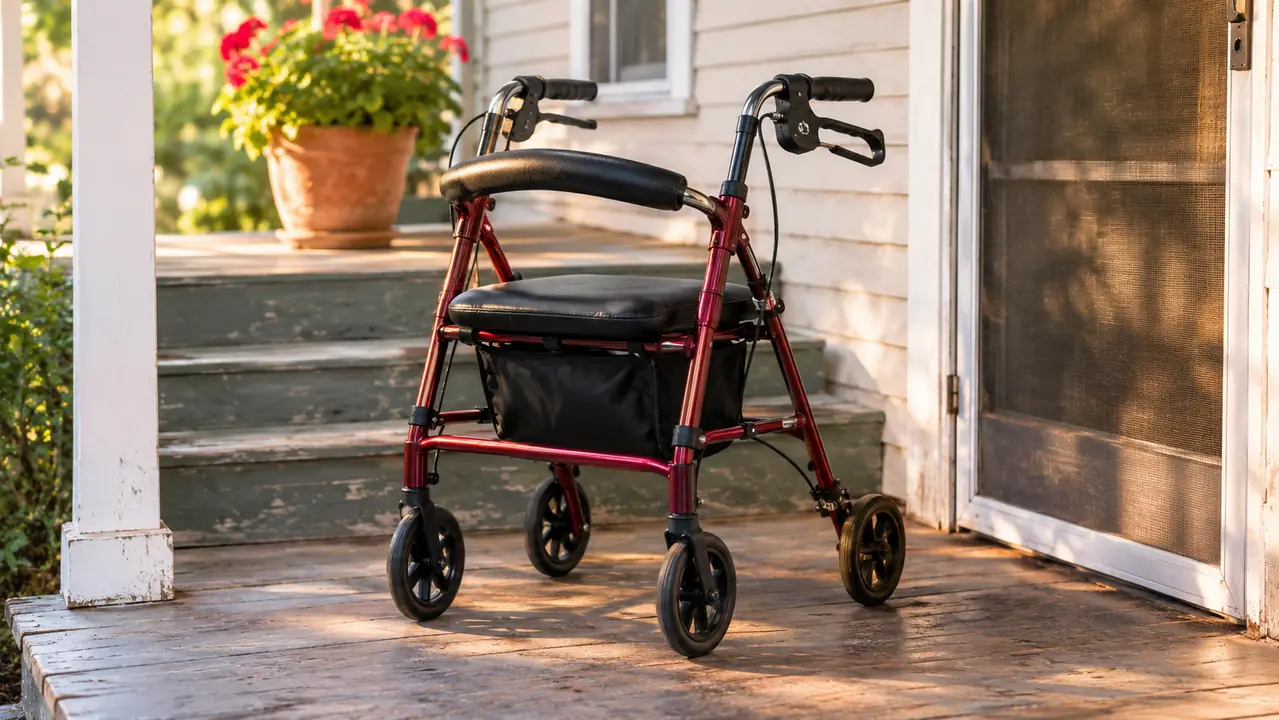
If you are choosing between a Drive Medical rollator and a Medline rollator, the short answer is this: they solve the same basic problem in two slightly different ways, and the better pick depends on how you will actually use it. The Drive Medical Rollator Walker with Seat has a steel frame rated to 350 pounds, 7.5 inch wheels, a fold-up removable back support, and a listed weight of 20 pounds. I have owned that exact one since the week before my left knee replacement four years ago. It lives in my garage in Dayton now, folded against the wall next to the snow shovel. I have not owned the Medline. I looked at it, read what it comes with, and asked my physical therapist Dana enough questions that she finally laughed at me. So I will tell you plainly where my own rollator wins, where the Medline wins, and which person each one really suits.
Before I get into the table, one thing about how I am writing this. I am not a doctor and I am not a physical therapist. I am a 71-year-old retired music teacher in Dayton who has pushed a rollator around a grocery store, a farmers market, a county fair, and about half a mile of neighborhood sidewalk. What I can give you is the day-to-day truth of living with one of these. What I cannot give you is medical advice. Ask your own therapist before you change equipment, the way I ask Dana. She is the reason I bought the Drive Medical in the first place, and she is the reason I set the brakes before I sit down.
| Drive Medical Rollator | Medline Rollator | |
|---|---|---|
| Listed weight | 20 pounds, steel frame | Aluminum frame options run noticeably lighter |
| Weight capacity | 350 pounds | Lower capacity on most Medline models |
| Seat and backrest | Padded seat, back support folds up and lifts off | Padded seat, backrest typically fixed in place |
| Wheels | 7.5 inch wheels for sidewalk and parking lot surfaces | Smaller wheels on several models, fine indoors |
| Getting it into a car trunk | Heavy enough that I plan around it | Easier for one person to lift and fold |
| Lifting it up stairs | Difficult at 20 pounds on a bad knee day | More manageable for a two-story house |
| Brakes | Loop brakes on both handles, squeeze to slow, push down to lock | Loop brakes on both handles with a locking push-down |
| Handle height adjustment | Height adjustment lever, fits users from 59 inches up, maximum height 35 inches | Adjustable, range varies by model |
| Storage | No built-in bag or basket in the base listing | Several Medline models ship with a pouch or basket |
| Best for | Heavier users, outdoor walking, long days out | Smaller users, tight hallways, frequent car trips |
Where the Drive Medical Rollator Wins
The first thing I will say in favor of the Drive Medical is that it has never once felt unsteady under me. The steel frame is rated to 350 pounds, and you can feel that when you lean on the handles to stand up from the seat. My husband Gene is 5 foot 10 and a good deal heavier than I am, and when his right hip gave out at the county fair 14 months ago, he used my rollator for the rest of the afternoon without a word of complaint. He had said no to it for months before that. He walked half the fairgrounds with his hands on those handles and did not argue with me once, which for Gene counts as a speech. A lot of rollators are rated lower than people assume, and if you are a bigger person, or you set a bag of groceries on the seat and lean on it, that number is not a detail on a spec sheet. It is the difference between a tool and a worry.
The second thing is the seat and backrest arrangement. The back support folds up and lifts off entirely, which sounds like a small thing until you want to sit down without a bar in your back, or you want the whole rollator to go flat against the garage wall instead of standing out where you trip on it. The seat is padded and sits at a height where I can lower myself down and push back up without help from anyone. I used it every single day for the first three months after surgery: in the kitchen while dinner cooked, in the church hallway between services, in the checkout line at the grocery store when the line was longer than my knee was willing to stand for. By month four I was doing the neighborhood loop, about half a mile, with one rest on that seat at the corner where the sidewalk turns. I still sing alto on Sundays, and standing through a long rehearsal is the test I measure my knee by. The seat is what gets me through the second half of it.
The 7.5 inch wheels are the third piece I would defend, and they are the reason I would not trade down to something smaller. They roll over the raised seam in the sidewalk at the end of my block, the gravel shoulder at the farmers market, and the rough asphalt patch in the church parking lot where a pothole was filled badly about three years ago. Small hard wheels catch on a seam like that and stop dead, and a stopped rollator with you leaning forward on it is a bad moment. I have pushed mine through two winters of salt and grit on that sidewalk and the wheels still turn true. If your walking happens outdoors, on real pavement, that size is worth having, and I would pay attention to it before I paid attention to anything cosmetic.
Four years in, here is what has worn and what has not. The seat padding has flattened a little on the left side, where I always sit. The rubber on the handle grips has gone slightly smooth at the spot my palm lands. Everything else is original: the frame, the wheels, the brakes, and the folding mechanism that lets the back support lift off. I have never tightened a bolt on it. It has been rained on at the fair, left in a hot garage every summer, and folded and unfolded more times than I could count. The warranty is a limited lifetime and I have never had to use it, and I would rather tell you that honestly than pretend I have tested their customer service. If something had broken, I would be telling you that instead.
The one I have kept in my garage for four years
Steel frame rated to 350 pounds, 7.5 inch wheels, padded seat, and a backrest that folds up and lifts off. It is not light. It is steady.
Amazon Check today's price on Amazon →
Where the Medline Rollator Wins
Here is where I have to be honest, because I have lifted my own rollator in and out of our four-door sedan more times than I can count, and it is the one thing about it I genuinely resent. Twenty pounds does not sound like much until you are lifting it into a trunk at 7:40 on a Sunday morning with a replaced knee and a choir robe over your arm. I am the one who takes the car on Sundays and Gene rides in the passenger seat, so on the mornings I bring the rollator to church I load it myself, because he cannot lift it either. Medline makes rollators in aluminum, and aluminum is lighter. I have picked up a friend's aluminum rollator in the church narthex, and the difference is not subtle. If you load and unload by yourself several times a week, or you live in a two-story house with the bedroom upstairs the way we do, the lighter frame is a real advantage and I would not talk you out of it.
The second concession is storage. My Drive Medical does not come with a bag, a basket, or a pouch in the base listing. For four years I have carried a canvas tote hooked over one handle, and it swings against my hip when I walk and tips over if I take a corner too fast. Medline sells models that come with a pouch or a basket already attached, and several of them fold to a narrower footprint. That matters more than it sounds. The hallway between my kitchen and my front room is narrow, and the three steps up to my front door are shallow, and a narrower rollator is easier to get through a bathroom door without turning sideways first. If your walking is mostly indoors, bedroom to kitchen to bathroom, a smaller-wheeled lighter rollator with a basket is a sensible pick. You will not miss the 7.5 inch wheels because you are never on a sidewalk.
I should tell you how close I came to buying one. About a year ago, when it was clear that Gene was going to need something for long outings and we were tired of resetting the handles on mine, I sat at the kitchen table with the laptop and read through the Medline listings for an hour and a half while the coffee went cold. What stopped me was not the rollator. It was that we already had one that worked, and buying a second one for a man who had refused a cane for eleven months felt like getting ahead of myself. If I were buying today, for a smaller person who walks indoors and loads her own car, I would look hard at the aluminum Medline before I looked at anything else. I have not owned one. I have handled one, and I have read the listings the way I read a recipe before I cook it, and I would not steer you away from it.
Twenty pounds does not sound like much until you are lifting it into a trunk at 7:40 on a Sunday morning with a replaced knee.

What the Two Have in Common
Both are four-wheel rollators with a seat, both brake with loop handles you squeeze to slow down and push down to lock, and both adjust for handle height so two people of different sizes can share one. That last point is not theoretical in our house. Gene and I reset the handle height between us every time he takes mine out, and it takes a few seconds with the lever. If you are buying one rollator for two people, check the height range carefully before you spend anything. The Drive Medical listing gives a minimum height recommendation of 59 inches and a maximum handle height of 35 inches. I am 5 foot 4 and Gene is 5 foot 10 and we both fit inside that range, but he is near the top of it and I would not want to be an inch taller. Measure yourself against the numbers on the listing, not against what the photograph looks like.
Both also ask the same thing of you, which is that you set the brakes before you sit down. I learned that the ordinary way, which is that I did not, once, in my own kitchen, with a cup of coffee in one hand and my mind on the phone bill. The rollator rolled back about four inches while I was halfway to the seat, and I sat down harder than I meant to, spilled the coffee, and sat there laughing because crying would have been worse. Nothing happened. It scared me enough that I have set the brakes every single time since, and I now check them on Gene's side too before I walk away from it.
Both of them also teach you the same lesson about your own house, which is that you find out where your rugs are. Mine caught the corner of the hall runner the first week until I taped the runner down. Thresholds between rooms need a small lift of the front wheels, and after a few days you do it without thinking about it. Gene's cane base catches on those same thresholds, which is one reason we keep the rollator for the long days and the cane for the short ones. Neither rollator floats over a doorsill. If someone tells you theirs does, they are remembering it more kindly than it happened.
Who Should Buy Which
Buy the Drive Medical if you are a heavier person, if your walking happens outdoors on sidewalks and parking lots, if you want a backrest you can lift off, and if you are willing to plan around the weight. In our house that means it goes to the farmers market on Saturday and to church when my knee is complaining, and it stays in the garage for a five-minute errand to the drugstore. I have learned to decide before I leave the house whether I am taking it, rather than deciding once I am already standing beside the car. That one habit fixed most of my resentment about the weight. If someone else loads the car for you, the weight stops being a problem at all, and what is left is a sturdier rollator than most of what I looked at.
Buy the Medline if you are smaller, if you walk mostly indoors, if you load your own car several times a week, or if you want a basket without rigging one yourself out of a tote bag. It is the better answer for a tight hallway and a second-floor bedroom. It is also the one I would suggest for a person who is not sure yet whether they will keep using it, because a lighter rollator is less of a chore to get out the door, and the rollator you actually take with you beats the better one sitting in the garage. That is not a small point. The best piece of equipment in the world does nothing for you folded against a wall.
If you are in the first stretch after surgery, the way I was four years ago, do not buy anything until your therapist has watched you walk. Dana picked the Drive Medical for me and she was right, but she was right because she had watched me stand up out of a chair and walk the length of a hallway, not because of anything printed on a box. She also told me to set the brakes and to keep the handles high enough that I was not stooping, and both of those mattered more than the model did. Bring the numbers from the listing to that appointment. Ask whether your own height, your own weight, and your own hallway fit the thing you are about to order.
And if your husband or your wife is the stubborn one, the way mine was, do not push. Gene said no for months. He said no when I offered, he said no when Dana suggested it, and he said no in the car on the way to the fair. What finally did it was a bad afternoon when his hip gave out halfway around the fairgrounds and I had to walk back to the car for the rollator myself, and he stood there holding a fence post waiting for me. He used it the rest of the day. He has used it for every long outing since, the fair and the farmers market both. Offer it, leave it in the corner where it can be seen, and let him come to it on his own feet. That is the only method that ever worked in this house.
Still the one I would buy again
Four years, one knee replacement, one stubborn husband, and it has held up. Rated to 350 pounds, with 7.5 inch wheels and a seat I trust to sit down on.
Amazon Check today's price on Amazon →