
I bought this reacher three years and ten months ago, two months after my left knee replacement, when picking a dropped sock up off the bedroom floor had turned into a decision I had to plan for. I am 71 now, 5 foot 4, and I live in a two-story house in Dayton with three steps up to the front door, so bending and climbing are not abstract ideas to me. The ZAYAD reacher grabber sat in my cart for eleven days before I ordered it. That is how you know I was not excited about it. I was tired of asking my husband Gene to fetch things, and I was tireder still of the pride that came with asking.
Here is what nobody tells you about a reacher. It does not give you your reach back. It gives you back the things you dropped. That is a much smaller promise, and it is the honest one, and once I understood it I stopped being disappointed in the tool. The ZAYAD does that smaller job well. It also has limits I did not see coming, and I want to lay every one of them out before I tell anybody to spend their money.
The Quick Verdict
Good at light, everyday pickups and easy to fold into the car. Not a lifter, not a grab rail, and the grab takes a couple of weeks to learn.
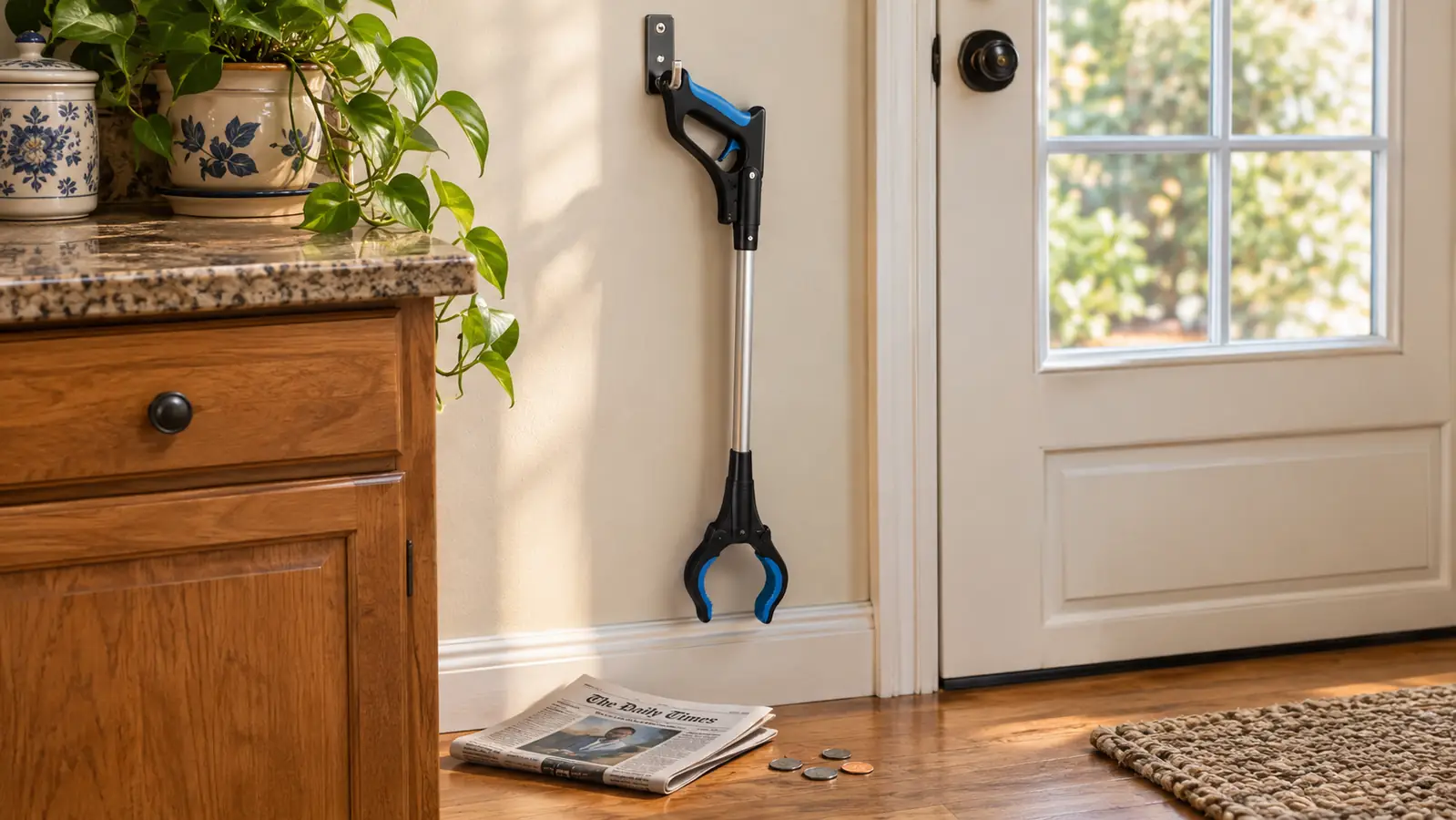
Amazon Check Today's Price →The reacher that lives on a hook by my kitchen door, not in a drawer
Three years and ten months of daily use, one folding tool, and I still have not had to kneel on this floor for a coin. Light things only, and it will not hold your weight, but it does the job it was built for.
Amazon Check Today's Price on Amazon →What Nobody Tells You Before You Buy One
The catalogs make a reacher sound like independence in a box. Mine was not that. Mine was a long arm with a grip at one end that sat by the kitchen door and made me feel old for about a month. I say that plainly because I have read plenty of write-ups that skip it. The first two weeks I used it badly. I would snatch at a coin and catch only a corner of it, or I would pull the grip too early and the grabbing end would close on air, and then I would set the thing down and get on my hands and knees anyway, which defeated the entire point of owning it.
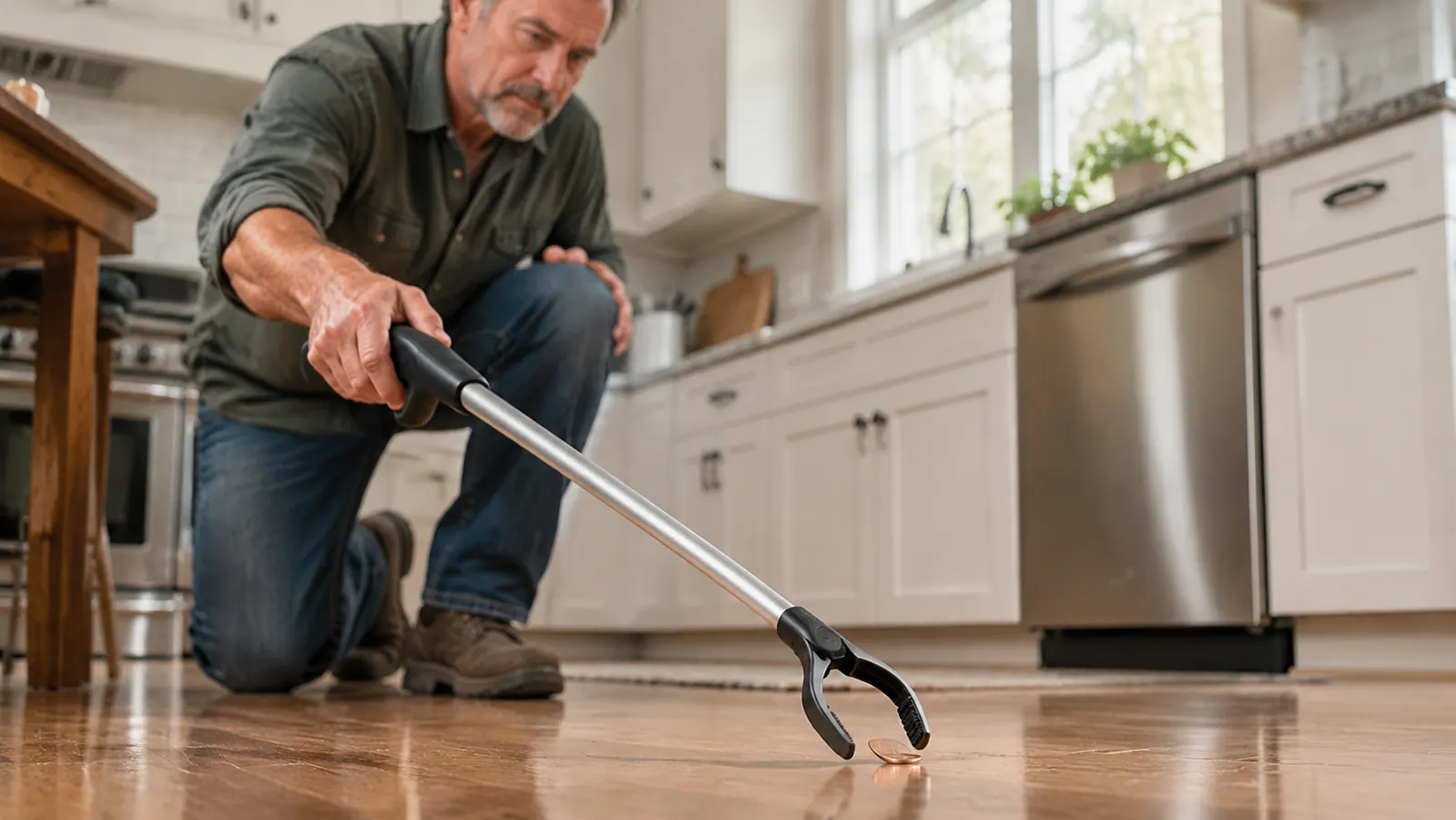
The grab takes practice. That is the whole first lesson and nobody puts it on the box. The end of the tool closes when you pull the grip at the top of the handle, and it closes cleanest if you pull slowly and evenly instead of snatching. Coins, envelopes and trash are exactly what the listing says it is built for, and the listing is not exaggerating. What the listing leaves out is that an envelope lying flat is easy and a dime standing on edge is not, and that a dime on a hardwood floor will take you three tries until your hand learns the trick.
I would also tell anyone this before they order. A reacher does not make you steadier. It makes your hand longer. If balance is the thing that worries you, a longer arm does not fix it, and in a small room it can make the problem worse, because now you are leaning further out over your own feet than you would have without it. My physical therapist Dana put that in my head four years ago and she was right, as she usually is.
How I've Used It for Three Years and Ten Months
It hangs on a hook by the kitchen door. That hook matters more than you would think. A reacher in a closet is a reacher you do not use, and I have heard from more than one friend who bought one and buried it behind the broom. Mine is at shoulder height on a path I walk past forty times a day, so when the mail hits the floor the tool is already in my hand before I have decided anything. The newspaper on the porch is the same story. The coins that roll under the couch are the same story.
The couch is where it earns its keep. Gene and I have a couch with about four inches of clearance underneath, and every remote, every pen and every nickel in this house ends up down there. Before the reacher, that meant a flashlight and a bad attitude. Now it means reaching down and pulling back up. I have also used it on the second shelf of the pantry, on a folder of choir music that slid behind the piano bench, and on a prescription bottle that went under the passenger seat of our sedan. None of that is heroic. All of it is the reason a person keeps one on a hook.
Gene borrows it, which is its own kind of review. He is 74, he has a weak right hip and balance trouble that got worse over the last two years, and he will not ask me for help if there is any other option available to him. He takes the reacher out to the garage and does not always hang it back up. I have found it on the workbench, in the car, and once on the back steps in the rain. The tool survived all of that. It has not survived my temper about it.
The Fold Is the Whole Point, and It's Also the Catch
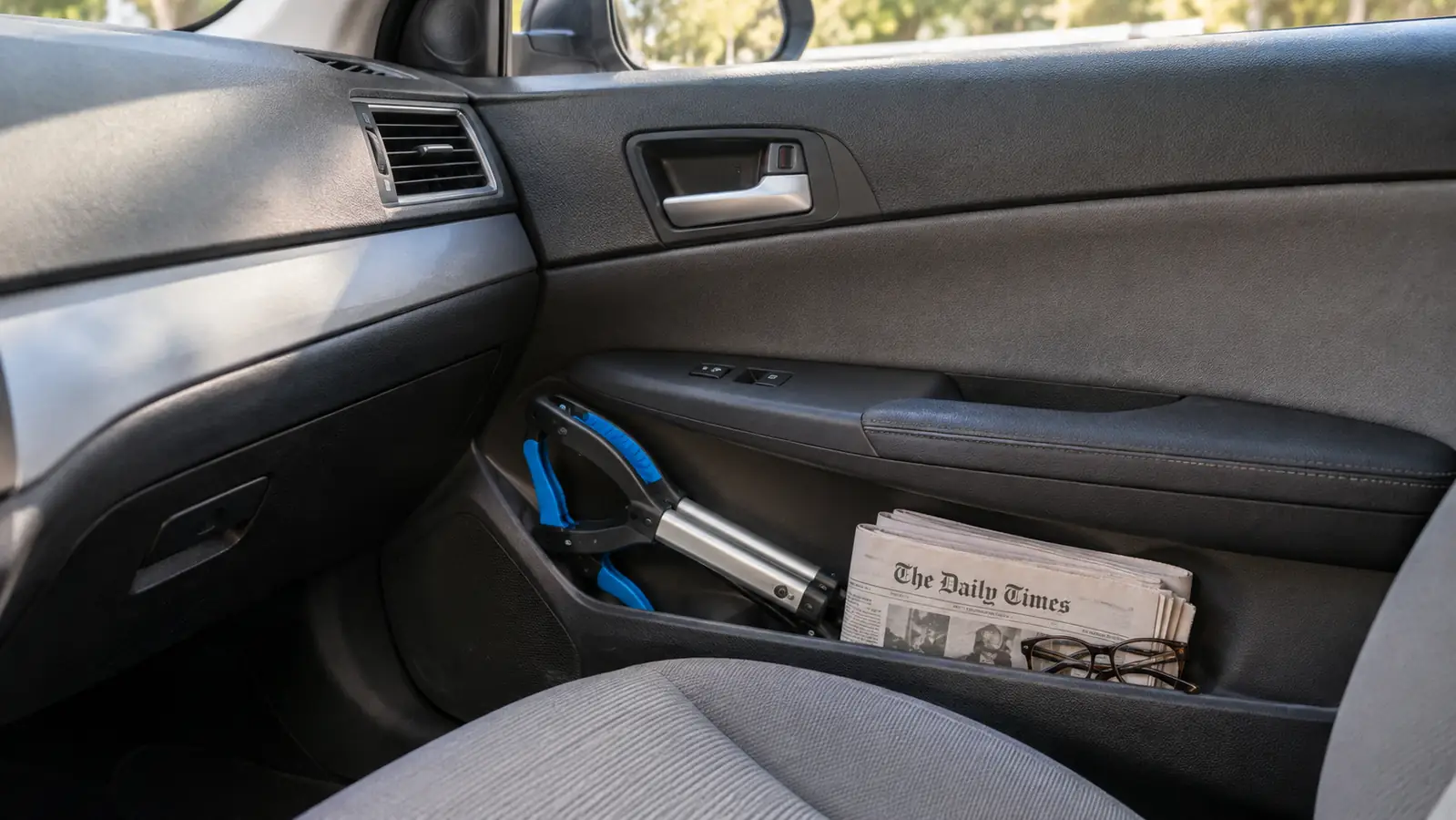
The tool is foldable, and that is the feature that made me pick this one over a plain solid reacher in the first place. It folds down and goes in the car, in a drawer, in a closet, wherever you need it to go. I keep it folded in the sedan when we run errands, because the church parking lot is where things get dropped, not my kitchen. It weighs 8.6 ounces, light enough that I do not think about carrying it, and the listing gives the product dimensions as 17.7 by 5 by 1.6 inches.
The catch is simple and I have not seen it written down anywhere. A tool that folds has one more place to give than a tool that does not. I am not an engineer and I am not going to pretend to be one, but I have owned this for three years and ten months and I have learned to check that it is locked open before I put any weight behind it. Twice I have started to reach with it half folded and caught myself in time. That is a habit worth building on day one, not day thirty.
The 32 inch reach is the number that sold me, and it is enough for the floor, the low cabinet and the gap under the bed. It is not enough for the top of my kitchen cabinets, which is fine, because I should not be up there anyway. What I would tell you is to measure the reach you actually need before you order anything. Mine is for the floor and the porch and the space under the couch, and for those three jobs it is more than sufficient.
What It Picks Up and What It Drops
Coins, envelopes, trash, the newspaper, a sock, a pen, a remote, the little plastic cap off a milk jug. Light things with an edge or a corner. The ZAYAD handles all of that without complaint. It has pulled a set of keys out from under the radiator and a hearing aid battery off a rug, and the battery is the smallest thing I have trusted it with. The grip is firm enough that I have never had a coin slip once the grabbing end was closed on it.
What it does not do is weight. I do not trust it with a full can, a drinking glass or anything breakable, and I stopped testing that after a jar of jam went over in the pantry about two years ago. That was my error, not the tool's error, but it is still the limit and it belongs in a review. This is a picker-upper, not a lifter. If you need to move a gallon of milk from the counter to the refrigerator, this is the wrong tool and your own two hands are the right one. I would rather say that plainly than have somebody learn it in a kitchen with glass on the floor.
The other limit is the one that matters most for readers like me. Using a reacher still means leaning. It means standing at the edge of a couch and reaching down and forward, and if that is a position your knee or your hip does not care for, a longer arm will not make it care for it. I brace my free hand on the counter whenever I can. Gene braces his on the door frame. That is not printed in any listing and it should be, because it is the difference between a helpful tool and a fall.
What I Liked
- Light at 8.6 ounces, so it goes in the car without a second thought
- Folds down for a drawer, a door pocket or a closet shelf
- 32 inch reach covers the floor, the low cabinet and the space under furniture
- Firm grip on coins, envelopes, keys and small trash
- Has held up to nearly four years of daily use and one rainstorm on the back steps
Where It Falls Short
- Not built for anything heavy or breakable, and I learned that the hard way
- The grab takes a couple of weeks of practice before it feels natural
- You still lean forward while using it, which is a real problem on bad balance days
- The fold is one more thing to check before you put weight behind it
- Gene keeps walking off with it
It has picked up a thousand coins off this floor, and I have not had to kneel for one of them since the spring after my surgery.
The Questions I Would Ask Before Buying Any Reacher
I am not a doctor, a nurse or a physical therapist and I never will be, so the only medical advice I have is the advice I took myself: ask before you change anything. I asked Dana three questions before I ordered this tool, and I would ask them again. First, is bending the thing I should be avoiding, or is it the leaning that goes along with it? Second, is there a height or a reach that would put less strain on my knee? Third, is there a movement I should be practicing so that I am not leaning on a tool for something my body can still do on its own?
Her answers were not the ones I wanted. She told me a reacher is a tool for a season or a bad day, not a replacement for the exercises, and she was blunt that the people who get the most out of one are the people who keep working on the things a reacher cannot do. I have thought about that a good deal in the years since. I still do my knee work on the stairs, and I still use the ZAYAD every single day, and I do not believe those two facts contradict each other.
One more thing nobody says out loud. If you live with someone who has balance trouble, buy two, or at least buy one and accept that it will migrate. Gene has claimed mine on and off for two years now, and a second tool would have spared us a fair amount of aggravation. I say that as a woman who watches the household budget like a hawk and hates buying anything twice.
Who This Is For
This is for the person who drops things and cannot get down to them comfortably. A knee, a hip, a back, a shoulder, any of it. It is for someone who wants the floor to stop being a project and the porch to stop being a negotiation. It is for the reader who will actually hang it somewhere visible instead of putting it in a closet and forgetting it. It is for the driver who wants something light in the door pocket for parking lots and curb strips. And it is for the person who can accept the small honest promise: your reach is not coming back, but the coins are.
Who Should Skip It
Skip it if you need to lift or carry anything heavier than a newspaper, because this is not that tool and it will let you down. Skip it if what you really need is something to hold your weight while you stand, because that is a different piece of equipment and treating a reacher like a grab bar is how people get hurt. Skip it if a weak grip or a tremor makes pulling the handle at the top difficult, since the grab only works as well as your hand does. Skip it if you are shopping for the top shelf. And if you have not asked your own doctor or therapist what you should be avoiding, ask first and shop second.
I am not going to tell you this tool gave me my independence back, because it did not. My knee, Dana's exercises and a rollator that lived in my garage for six months did that. What the ZAYAD did was smaller and, honestly, more constant than independence. It kept me off the floor. Three years and ten months in, it is still on the hook by the kitchen door, I still reach for it without thinking, and that is the whole review.
Small promise, kept for almost four years
It will not hold your weight and it will not lift anything heavy. It will pick up what you drop, fold into a door pocket, and save your knees the trip. Ask your therapist first, then take a look.
Amazon Check Today's Price on Amazon →