

I am not writing this to talk you out of the EMSON Car Cane, and I am not writing it to sell you one either. I am writing it because I have had two of them in our sedan for 18 months now, one in each front door pocket, and by this point I know exactly which parts of the listing hold up and which parts mean nothing in an ordinary driveway. Some of it is genuinely good. Some of it is true in a way that will not help you at all.
Here is the short version, and then I will explain it. It helps you get out of a parked car. It does not help you get in. It fits some door frames and not others, and you cannot tell which yours is until you try. And the two features that get the most ink in the description, the seatbelt cutter and the window breaker, are things I have never used and probably never will. That is not a complaint. It is just what the thing looks like after a year and a half of being opened and closed in a grocery store parking lot.
For context on who is writing this: my husband Gene is 74, with a weak right hip and balance that comes and goes depending on the day and the weather. I am 71, and my left knee was replaced about four years ago after too many years of rec league softball. Between the two of us we own a rollator, a cane that stands up by itself, a bed bar, and a grabber on a hook by the kitchen door. The car was the last place we still had trouble, mostly because there is nothing in a car to hold onto except the door, and the door swings.
The Quick Verdict
A real solution for getting OUT of a parked car, sold with two emergency features most drivers will never touch, and useless for getting IN. Buy it for one job and you will be pleased. Buy it for everything and you will be disappointed.
Amazon Check Today's Price →One job, done well: check the listing and measure your door latch before you order.
The two-pack is the version that makes sense if two people share a car, which is exactly why we have one in each front door pocket. Look at the fit notes on the listing first.
Amazon Check Today's Price on Amazon →The Morning That Made Me Order It
It was a Sunday, which matters, because Sundays are when I drive us to church and Gene rides in the passenger seat. We came out after the service into a parking lot that was full and busy, and Gene could not get up out of the car. He tried once and sat back. He tried again with his hand on the dashboard and sat back. On the third try he took my arm, and I pulled, and he came up, and something in my left knee said a word I will not repeat here. It hurt for two days afterward. I ordered the EMSON two-pack that afternoon from the kitchen table with my coffee still going cold.
I want to be fair to Gene in this. He had refused a rollator for months before the county fair finally changed his mind, so I expected a fight about the car cane too. There was no fight. He unwrapped it, slid it down into the door latch, and got himself up on the first try without a word. Then he looked at me and said, well. That was the entire review. If you have been married 46 years you know exactly how much a well carries.
How It Actually Works, in Plain Terms
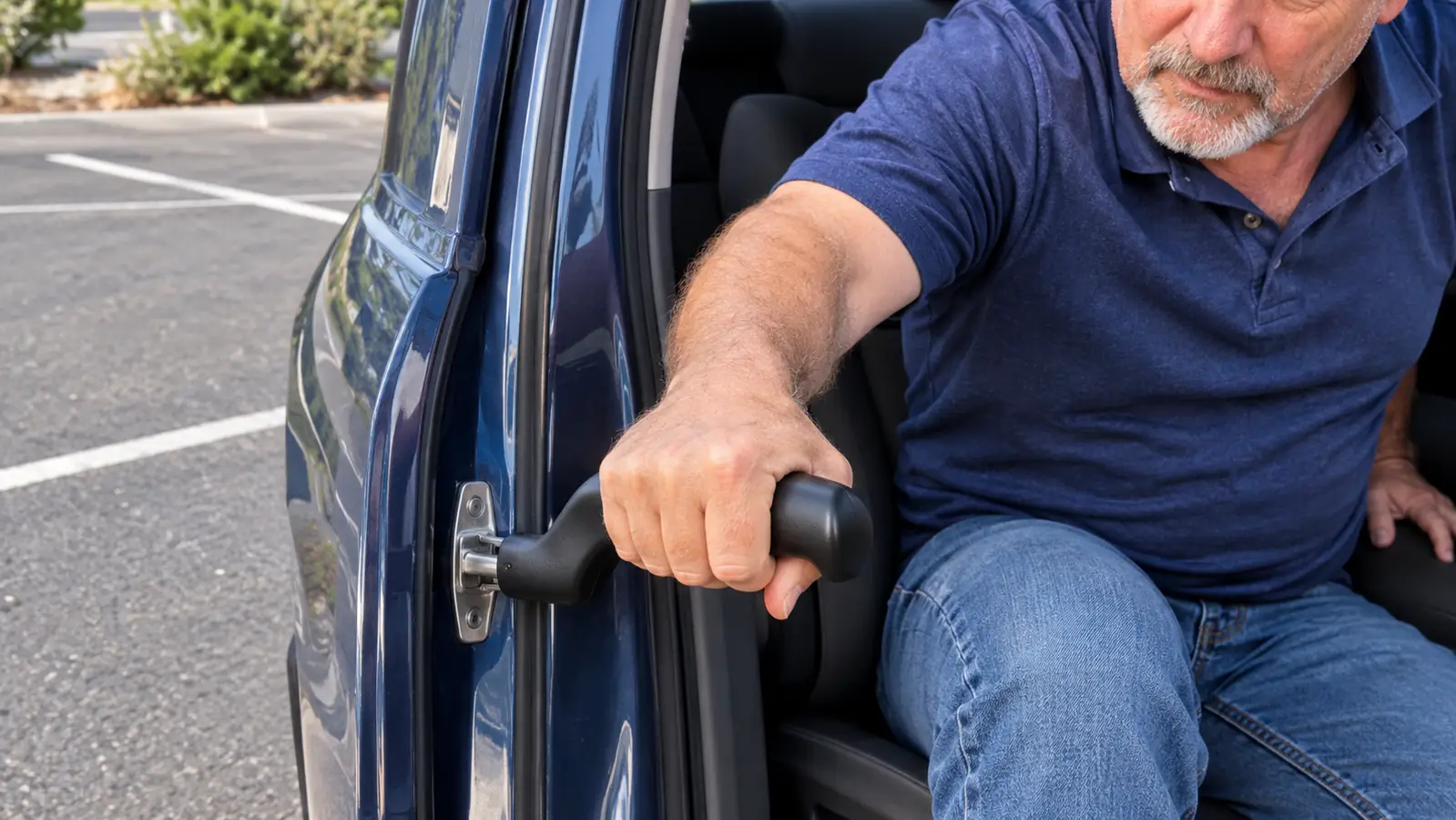
The EMSON car cane is a short steel handle that drops into the U-shaped latch on the door frame, the same notch the door clicks into when you shut it. The listing gives the dimensions as 8 inches long and 2 inches wide, and it is forged steel rated to support 350 pounds. It has a feature listed as lockable, and what that means in practice is that it seats down into the latch and stays there while you put your weight on it instead of sliding out from under your hand. It is ambidextrous, so it works in either front door, which is the reason we bought the pair rather than one.
You use it only when the car is parked. That sounds obvious written out, but I want to say it clearly because I have seen people ask whether it can be left in place while driving. It cannot, and it should not be. It goes in when you stop and it comes out when you leave. Ours live in the door pockets between uses, which is convenient and also means they rattle around a bit on rough roads. That is the tradeoff for having them where you need them.
What It Does Well
Getting out got easier in the first week and stayed easier. That is the honest headline. Instead of pushing up off the seat with nothing but the door and my arm, Gene has a fixed vertical handle to pull against, and the difference in his face is visible. It is not that he moves faster. It is that he stops bracing himself beforehand, and that bracing was most of the strain on both of us.
The second thing it does well is that it takes me out of the equation. For years I was the handrail. I would stand at the passenger door and he would take my arm, and my knee would absorb whatever his hip could not manage that day. Now he does it himself and I stand nearby and pretend to be looking at something else, which he prefers and so do I. Nobody wants to be hauled out of a car by their wife in front of the church crowd, and I want to be honest that some of the value here is dignity, not mechanics.
The soft grip is better than I expected. It is a knob-style handle with a nonslip surface, and in the rain, with a wet hand, it still holds. The pair is listed at 16 ounces, so it is nothing to keep in the car, and I have never once hesitated to bring both along on a long drive.
What Nobody Tells You
The EMSON handle does not help you get into the car. This is the single biggest thing I would want a stranger to know before ordering, and it is not a flaw exactly, it is just the geometry. The handle sits in the door latch on the frame, so it is behind you and below your hip when you are standing outside trying to sit down. What it helps with is the push up and out. Getting in is still a controlled lowering into the seat, and if that is your hard part, this will not fix it. For Gene the getting out was the hard part, so we got lucky.
It does not fit every car. I have read enough reviews from other people to know that some door latches are shaped or recessed in a way that will not accept the handle cleanly, and some vehicles have trim or weatherstripping that gets in the way. Our sedan takes it fine in both front doors. That does not promise anything about your car. Before you order, go out and look at the latch on your own door frame, and if you can, check the listing's fit information against your make and model. If it does not seat all the way down and lock, it will rock under your hand, and a handle that rocks is worse than no handle.
It is not a substitute for a rollator, a cane, or a physical therapist. On a bad hip day Gene still uses his cane to walk from the car to the door. The car cane gets him out of the seat. It does not get him across the parking lot. I have seen listings for products like this written as though they solve the whole problem, and they do not. They solve one six-second problem, and they solve it well.
The Two Features You Will Probably Never Use
The listing leans hard on the built-in seatbelt cutter and the window breaker, and I understand why. Those are the features that make a shopper feel like they are getting more than a handle. In 18 months I have not cut a seatbelt and I have not broken a window, and I hope to keep that record. I do not think they are a reason to buy. I also do not think they are a reason not to. They sit at the end of the tool and they add nothing to the weight in any way I notice.
The LED light I do use, though not for anything dramatic. It is bright enough to find the keyhole in a dark lot, and to see what rolled under the passenger seat, and to check that I have not left my purse on the floor. Batteries come included. I have not had to change them yet, and I could not tell you where they go without going out to the car and looking. That is how much thought the light has required of me.
What I Liked
- Makes getting up and out of a parked car noticeably easier from the first week
- Rated to 350 pounds, forged steel, feels solid under a real hand rather than flexing
- Ambidextrous, so one works in either front door, and the two-pack covers both seats
- Soft nonslip grip holds up with wet hands in the rain
- Seats into the door latch and locks, so it does not slide out from under you
- Only 16 ounces for the pair, so it lives in the door pocket without being noticed
- The LED light is genuinely useful in a dark parking lot
Where It Falls Short
- Does nothing for getting into the seat, only for getting out
- Does not fit every door latch, and you cannot know until you try yours
- Must be removed before driving, so it is one more thing to remember
- The seatbelt cutter and window breaker are selling points you will likely never use
- Rattles in the door pocket on rough roads
For years I was the handrail. The EMSON car cane took me out of that job, and both of us are better for it.

Living With Two of Them in the Car
Eighteen months in, the two EMSON handles have settled into a routine. Gene's lives in the passenger door pocket. Mine lives in the driver door pocket, because my knee appreciates the help too on the days after a long choir rehearsal when I have been standing for two hours. We do not use them every single trip, which surprised me. On a good day Gene gets out of the car on his own and never reaches for it. It is the bad days it earns its place on, and there are enough of those in a year to justify a door pocket.
The one upkeep note is that they will pick up grit. Ours get wiped down maybe once a month when I clean the inside of the car, and that is the entire maintenance story. Steel does not care much about a parking lot. What I would watch is the latch area itself. If you drop it in with a handful of gravel in the notch, it will not seat properly, and you will notice because it moves.
Who This Is For
This is for someone whose hard part is the push up and out of a car seat, and who has a vehicle whose door latch will take the handle. That describes a lot of people after a hip or knee replacement, a lot of people with arthritis in the knees, and a lot of people whose balance has gotten unreliable in tight spaces. It is also for the spouse who has been doing the pulling, because the spouse is often the one who pays for it in their own back and knees. I was that spouse. That is not a small part of why I rate it as highly as I do.
It is also, I think, a good first step for someone who is not ready to admit they need anything. Gene would not accept a rollator for months. He accepted this without an argument because it is small, it lives out of sight, and nobody at the church sees him use it. Whatever gets someone safely out of a car is worth more than the thing they refuse to buy.
Who Should Skip It
If your difficulty is getting into the car rather than out, skip it. If you need support for walking from the car to the store, skip it and look at a rollator or a cane instead, because this will not help you across a parking lot. If you drive a vehicle where the latch is recessed, or where the trim blocks the notch, skip it, or order from somewhere you can return it without a fight. And if the person you are buying for has significant balance trouble and is unsteady on their feet once upright, this does not steady them, it only helps them rise. Gene's cane does the steadying. This does the rising.
One more group. If the person you are shopping for will not carry anything into the car, or will forget it, or will leave it on the seat and drive off with it, think about that. It has to go in and come out every time. A handle that lives in the trunk is a handle that does not get used.
What I Would Ask Before Buying One
Ask your doctor or your physical therapist first, and I mean that plainly, because I am a retired music teacher and not a medical person of any kind. I asked Dana, the physical therapist who got me through my knee, and her answer was that a fixed handle to pull against is generally easier on a healing joint than pulling on a person, but that it depends entirely on the individual and on which side is weak. She also told Gene to keep using the cane to walk, which he does. If you are recovering from surgery or a fall, get your own advice. What worked in our driveway is not a prescription for yours.
The second thing I would do is measure. Go look at the latch in your door frame, note where the trim sits, and compare it to the 8 inch by 2 inch footprint listed for the handle. That five minutes is worth more than any review, including this one. If the seller offers a return window, know what it is before you open the package, because the one real failure mode here is a car it does not fit.
What I Would Change
I would put the fit information louder and earlier in the EMSON listing, and I would describe the getting in versus getting out distinction in the first paragraph instead of leaving shoppers to work it out from reviews. I would also like a small clip or strap to keep the pair from sliding around in the door pocket, though that is a minor gripe about a product that is doing its job. And I would happily trade the window breaker for a slightly wider base if that made it fit more vehicles, because the breaker is doing nothing for us and the fit is the only thing that ever worried me.
None of that changes my recommendation. Two of these have lived in our car for a year and a half, they get used most weeks, and they solved the specific problem I bought them to solve. That is not a five-star story about a wonder product. It is a four-star story about a simple tool that does one thing and does it, sold with some extras I ignore and a fit question you have to answer for yourself.
If getting out of the car is the hard part, this is the simplest fix I know of.
Check the fit against your own door latch first, then decide. Eighteen months in, ours are still in the door pockets where they started.
Amazon Check Today's Price on Amazon →