

The church parking lot on a Sunday morning is where I finally said it out loud. Gene had been working at getting up out of the passenger seat for the better part of a minute, my hand was under his arm, and my left knee, the one I had replaced about four years ago, was filing a formal complaint. It took him three tries. He got up on the third one, straightened his jacket, and we walked in like nothing had happened. That was eighteen months ago. The following week I ordered the EMSON Car Cane two-pack, and one of them went into his door pocket and the other into mine.
I'm Lorraine Dubois. I'm seventy-one, I taught elementary music in Dayton for a long time, and I sing alto at church on Sundays. I am not a doctor, a nurse, or a physical therapist, and I want that on the record before we go any further. I'm a woman with a replaced knee and a husband with a weak right hip and balance that is not what it was. What follows is eighteen months of plain use, including the parts that irritate me.
The Quick Verdict
It ended the parking lot tug of war inside the first week. It does not help you get into the seat, and it does not fit every car, but for getting out it has earned its place in both of our door pockets.
Amazon Check Today's Price →The two-pack that lives in both front door pockets now
Forged steel, rated to 350 pounds, and it slides into the latch on the door frame so you have something solid to push against instead of a spouse's forearm. It comes as a pair, which is why Gene and I each have one.
Amazon Check Today's Price on Amazon →How I've Used It
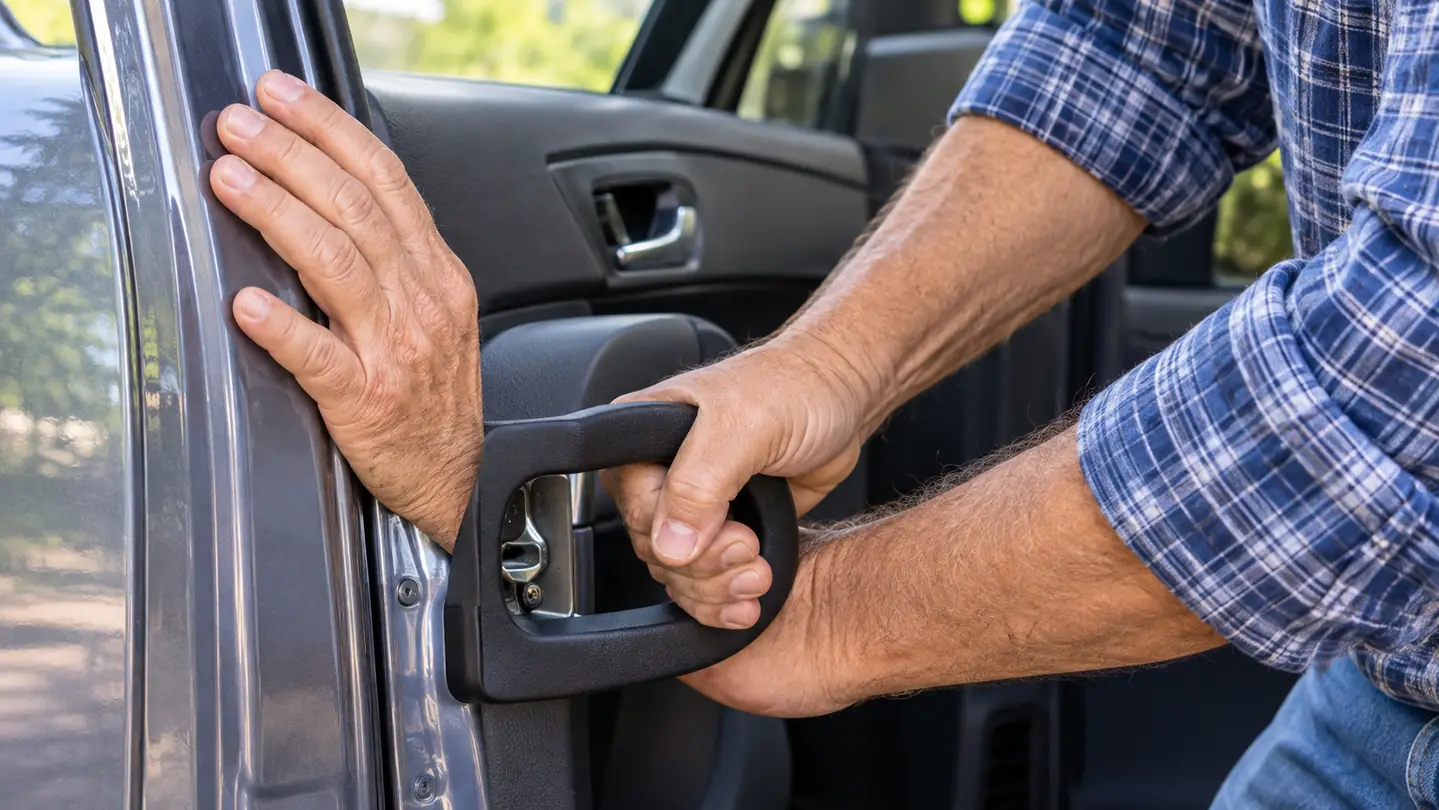
Here is the whole method. You open the car door, you slide the handle into the U-shaped latch on the door frame, and it locks in place. Then you swing your legs out, put your hand on the grip, and stand up against something that does not move. That is the entire idea, and it took me longer to describe than it takes to do. The EMSON unit is forged steel, rated for 350 pounds, and the grip is a soft knob you close your hand around. That is all I need from it, and that is what it does.
Where ours live: Gene's is in the passenger door pocket, mine is in the driver's door pocket. We drive one four-door sedan between us. I drive on Sundays, he rides. The handle comes out when the car is parked and goes back in the pocket before we pull away, every time. That is not a rule anyone gave us. It's just that the handle only makes sense against a parked car, and after eighteen months the habit is automatic.
I also want to be honest about what we tried first, because I know somebody reading this has already tried it. I was the assistive device. Gene would push up on the door frame with one hand and lean on my arm with the other, and I would brace. It worked, mostly, until the morning it didn't, and the cost of it was my knee, which is not a fair trade. Dana, my physical therapist, had told me for months to stop being furniture. She was right. I needed a Sunday morning in a church parking lot to hear it.
I looked hard at the Vive car handle before I ordered this one and wrote that comparison up separately, so I won't relitigate it here. The short version is that I wanted two handles rather than one, and I did not want to think about which car door I was in.
What the EMSON Car Cane Is, and What It Is Not
Physically it's a piece of hardware about eight inches long and two inches wide, steel, and the pair comes in at sixteen ounces on the listing. It does not feel like a gadget. It feels like a tool, the kind of thing that would still work if you dropped it on the driveway, which I have. The grip is soft and nonslip, which matters more than I expected in wet weather, and it's ambidextrous, so it does not care which hand you use or which door it's in.
The other things built into it: a small LED light with the batteries already in it, a seatbelt cutter, and a window breaker. I'll get to those in a minute, because I have opinions. What it is not is a way to get into the car. This is the part nobody tells you and the part I most want you to hear. The handle gives you something to push against on the way out. On the way in you are still lowering yourself into the seat with your own leg and your own arm on the door, and it does nothing for that.
The First Week, and What Actually Changed
Getting out got easier in the first week. Not dramatically. There was no light from heaven. What changed was small and specific: Gene stopped needing three tries. He plants both feet outside the car, puts his hand on the grip, and stands. The grip takes the weight his hip used to hand off to my shoulder, and I stand there with my hands in my pockets feeling useless in the best possible way.
The second thing that changed was quieter. I stopped flinching when he opened the passenger door. For about a year before we got these, every arrival anywhere was a small negotiation I braced for, whether it was the grocery store or the doctor's office or the church lot. I did not realize how much of my day went into anticipating that until it stopped. That is not a feature on the listing. It is the reason I would buy it again.
The first real test was the farmers market, on uneven asphalt with the car parked at a bad angle. He got out without me. Then he walked half a lap on his own and I went back for the rollator, because that is a different job and a different tool. What I noticed is that the two things now divide the work sensibly: the handle gets him out of the seat, the rollator gets him around once he's up. Before, both jobs landed on me.
Gene was the one who resisted. He said no to the rollator for months, he said no to a cane for eleven months, and he said no to this for about a week. What got him was not me arguing. It was the first Sunday he used it and stood up out of the car without me touching him. He didn't say anything about it. He just handed it to me to put in his pocket, which from Gene is a five-star review.
What Eighteen Months Has Done to It
Both handles are still in service. The grip on mine has a slight shine where my hand sits, and that is the only visible wear I can find. No rust, no wobble, no rattle in the latch, and the batteries that came with it are still doing the job on the light. Gene's has been dropped on a driveway and a sidewalk and shows it in one small scuff, which is cosmetic.
The habit has held up better than the hardware question, honestly. For the first couple of months I would catch myself forgetting to put it back in the pocket, and once it slid off the seat onto the floor mat while I was driving, which was the one time I was genuinely annoyed with the whole arrangement. Now it goes back in the pocket the way a seatbelt goes on. It took about six weeks to stop thinking about it.
The Parts I Don't Use Much
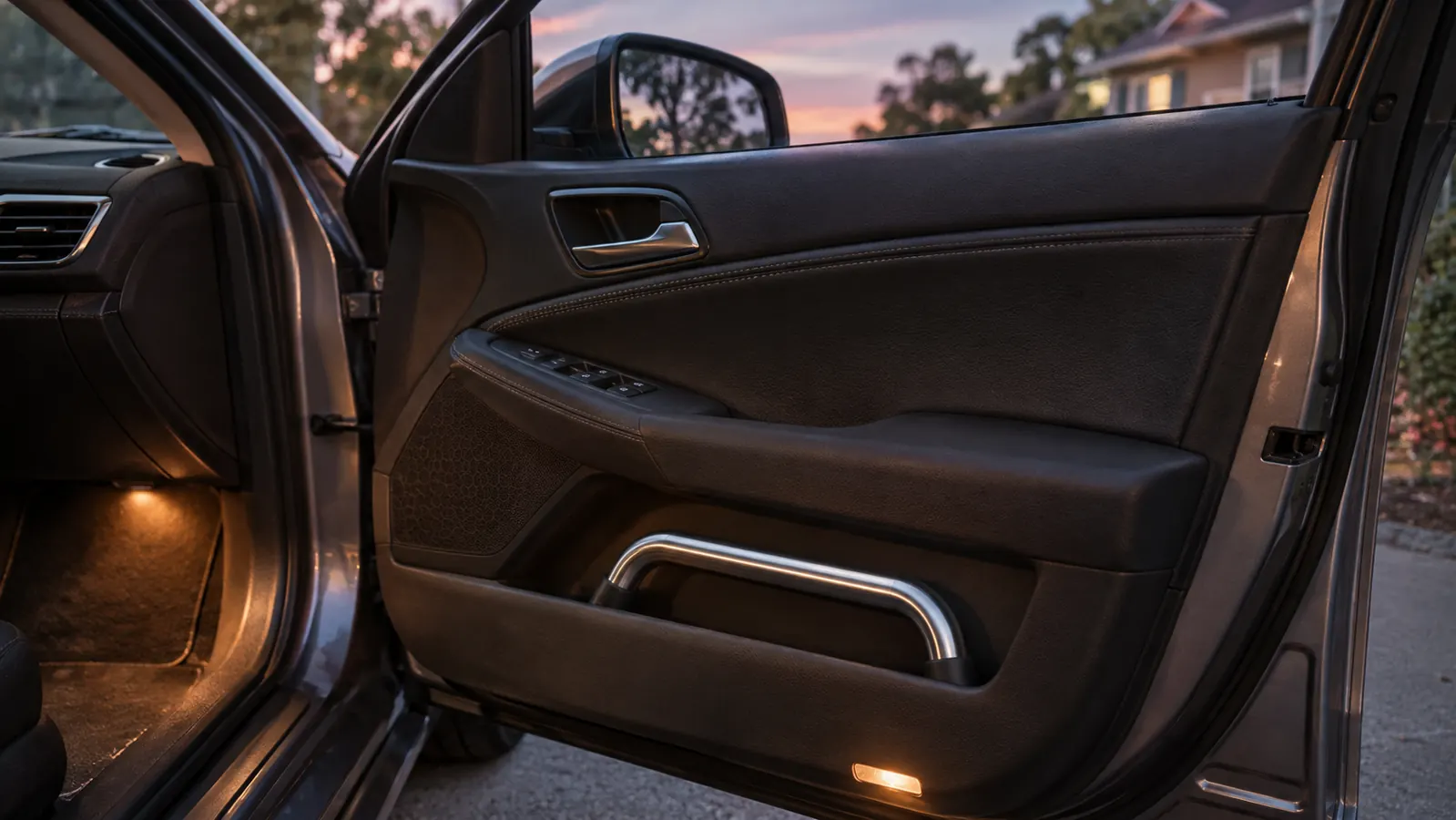
The LED light I use now and then, mostly to find the keyhole after dark, and it's brighter than I need for that. The seatbelt cutter and the window breaker I have never used. I want to say that plainly instead of pretending they're the reason to buy. Eighteen months in, they are a thing that is there if it is ever needed, and I hope it never is. If those two features are what is selling you, that's fine, but they were not what sold me.
The two-pack is the other thing worth talking about. I would not have bought one. We have two people with two different bad joints getting out of two different doors, and having one each ended a low-grade argument about who left it where. If you are buying for one person and one car, you will have a spare. Put it in the other door, or give it to the person who keeps saying they don't need one yet.
Where It Falls Short
It does not fit every car. Ours is a four-door sedan and both front door latches take it cleanly, but latch geometry varies from model to model, and a neighbor's car was fussy enough that I would not count on it. Check your own door frame before you plan around it. It is also a parked-car tool only. It is not meant to stay in the door while you drive and I would not do it. And the pocket habit has to become a habit, because a loose steel handle in a moving car is a bad idea in a way that is easy to forget.
The bigger limitation is the one I keep returning to. It helps you out, not in. Gene still has to ease himself down into the seat, and on a bad hip day that is the harder half of the whole business. We have not found a thing that fixes it, and this product does not claim to. If help getting in is what you are shopping for, this is not that, and I would rather say so now than have you find out in a parking lot.
And there is a pride issue, which is not the product's fault but is real. A car cane in the door pocket is visible. Gene noticed. There were a couple of weeks where he would wait until I was out of the car before he took it out. That passed. What I would tell anyone in that spot: give it a month before you decide how you feel about it. The first week is the worst of it.
What I Liked
- Ended the parking lot tug of war in the first week
- Forged steel with a 350 pound rating, and it feels like it
- Soft knob grip stays usable in wet weather
- Slides and locks into the door latch in a couple of seconds
- Two handles, so each door or each car gets one
- LED light is handy for finding the keyhole after dark
- Ambidextrous, so it does not matter which hand or which door
Where It Falls Short
- Does not help you get into the seat, only out
- Latch fit varies by car, so check yours first
- Only useful in a parked car, and it has to go back in the pocket each time
- Some owners will feel conspicuous using it at first
- Seatbelt cutter and window breaker are there for emergencies and nothing else
It took him three tries in the church lot that morning. Eighteen months later, he plants both feet, puts his hand on the grip, and stands. That is the whole review, really.
Who This Is For
This is for the household where getting out of the car has become a small event. If someone you love needs a hand under the arm to stand up from the passenger seat, and the person giving that hand is starting to feel it in their own shoulder or knee, this is a straightforward fix and it costs less than a dinner out. It is also for the person who gets out fine at home but not after a long drive, when everything has stiffened up by the time the engine is off.
It suits a two-person, one-car household like ours especially well, because you get a handle in each front door and nobody has to negotiate. And if you are the one who has been doing the pulling, I will say it plainly: your shoulder is not a medical device, and this is cheaper than the alternative, whatever the alternative turns out to be for you.
Who Should Skip It
If the trouble is getting into the seat rather than out of it, this will disappoint you. If your car's door latch does not take it, no amount of technique will fix that, so try before you commit. And if the person you are buying for cannot bear weight through one arm, or has been told by a therapist to use something with a base on the ground, this is not that thing. That is a conversation for your own physical therapist, not for me.
I would also skip it if the real problem is the walk from the car to the door. This handle stops at the door frame. It does not follow you across a parking lot. That is a rollator's job, and ours lives in the garage for exactly that reason.
Two handles, two door pockets, no more tug of war
The EMSON Car Cane comes as a pair, rated to 350 pounds, with a soft grip and an LED light. Check that your door latches will take it, keep it for parked cars only, and give it a month before you judge it.
Amazon Check Today's Price on Amazon →