

Gene sat on the edge of our bed for ten minutes one January morning and could not stand up. Not ten seconds. Ten minutes. I was downstairs in the kitchen and heard him call my name twice, and by the time I got up the stairs he had both hands flat on the mattress and was rocking himself forward, and I ended up hauling him to his feet, which my left knee did not appreciate one bit. That was twenty months ago.
The following week we ordered the Medline Bed Assist Bar and set it at the side of the mattress where Gene sleeps. He is 74. He has a weak right hip and balance that Dana, my physical therapist, describes, politely, as behind him. I am Lorraine, 71, a retired elementary school music teacher in Dayton, Ohio, and I am not a nurse, a doctor or a therapist. What I am is the woman who watches her husband get out of bed every morning of his life, which is its own kind of education. Dana is the one I call before I change anything, and I would tell you to do the same.
The Quick Verdict
A plain, sturdy handle that does one job. It gets my husband out of bed on his own in about fifteen seconds. It is not a bed rail and it will not catch a fall, so please do not buy it expecting that.
Amazon Check Today's Price →The handle that ended our ten-minute mornings
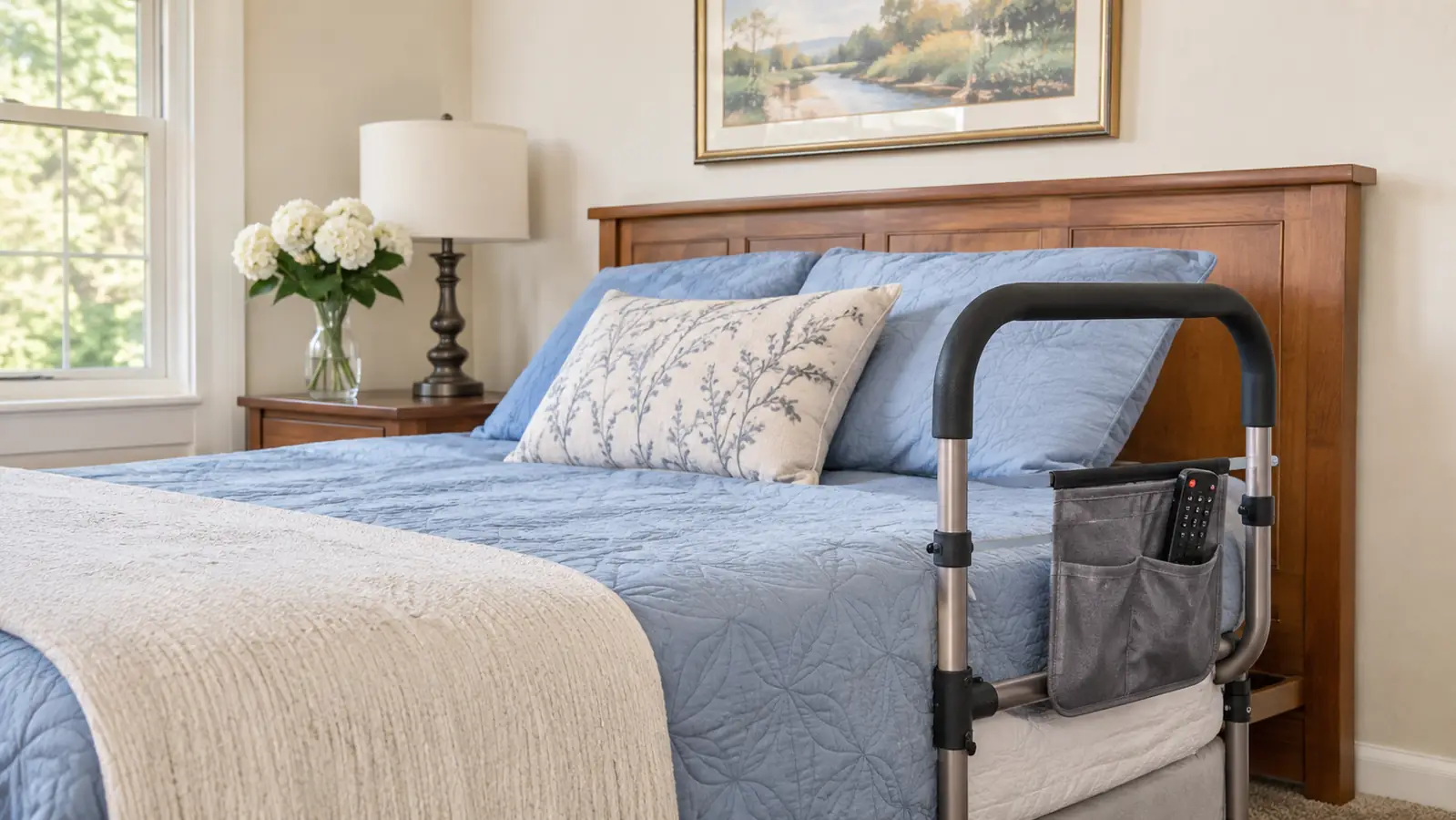
The Medline Bed Assist Bar is height adjustable, weighs 6.4 pounds, and has a nylon pocket for glasses, a book or the remote. It fits non-articulating twin, full and queen beds.
Amazon Check today's price on Amazon →How I've Used It
I have not used it, strictly speaking. Gene has, every morning and every night for twenty months, and I have watched from three feet away, which is close enough to have opinions. I tried it once. It sits at his height, on his side of the bed, and reaching across for it felt like putting on someone else's glasses. That is not a complaint about the bar. That is a note about how personal the height setting really is.
His routine, which Dana taught him, goes in four parts. Roll to the side. Plant both feet flat. Grab the bar with the hand on the strong side. Stand. The bar is what his right hand takes. His left hand pushes off the mattress for the first inch, and then he is up. Watching a grown man get out of bed in stages is not dignified and he would tell you so himself, but he does it without me, and that is the trade we made.
What changed after the first week was not his strength. His hip did not get better. What changed is that he stopped waiting on the edge of the bed for somebody to come get him. That waiting was the worst part, worse than the standing, because it made him feel like a patient in his own bedroom. The Medline bar removed that. I think about it a lot more than I think about the bar itself.

What the Medline Bed Assist Bar Is, and What It Is Not
It is a U-shaped handle, 6.4 pounds of it, height adjustable, with a nylon storage pocket that hangs off the side. The whole assembly measures 27.5 by 14 by 43.75 inches, and it is made for non-articulating twin, full and queen beds. Non-articulating means a plain bed that does not bend or lift at the head or the foot. Ours is a queen on a plain frame in the upstairs bedroom, and it is exactly the kind of bed Medline had in mind.
It is not a rail. I want that in capital letters somewhere on the box. A rail runs the length of the bed and keeps a person from rolling out. The Medline bar is one handhold in one spot at the side of the mattress, and if Gene's hip gave out halfway through a turn, it would not stop him from going down. We know that. It has not happened, but we know it, and I would rather write it here than have you find it out the hard way at two in the morning.
That distinction is why I am writing this at all. Most of the complaints I read about bed handles come from people who wanted a guard rail and bought a grab bar. They are different pieces of equipment for different problems. If the problem is rolling out of bed, you need a rail. If the problem is a body that will not lift itself off a mattress anymore, you need a handle, and this is a good one.
The Installation Took Twenty Minutes and One Argument
Gene did it himself, which was the argument. Box to done was about twenty minutes with me holding the mattress up off the frame so he could work. He had to back up and start over once, and the reason is worth telling you. He set the bar where it looked right from a standing position. It was too high. The height that matters is where your hand falls when you are sitting on the edge of the mattress with your feet on the floor, and that is a good four inches lower than where it looks right when you are upright.
So the method is this. Sit down. Let the arm hang. See where the hand lands. Set it to that, then get in and out of bed three or four times before you call it finished. Medline gives you that adjustment for a reason and it is the single most useful thing about the product. A handle at the wrong height is a handle you will not use, and I say that as a woman who has a rollator in the garage set to a height that only suits her.
Since that first week it has not moved. Our mattress is not a light one and it has not shifted the bar at all in twenty months of daily use. I check it about once a month anyway, on the same trip I make to test the smoke alarms, and it has never needed anything but a wipe with a damp cloth.
Twenty Months In: What Has Held Up
The honest answer is everything. The handle does not wobble. There is no bend in it, no rust, no rattle. Gene is 5 foot 10 and about 190 pounds and he leans on that thing with his full weight every morning and has done since the week we installed it. The nylon pocket has taken the abuse instead, and it is holding. The seams are fine. The only care it has ever needed is a damp cloth every couple of weeks, per the instructions.
The pocket turned out to matter more than I expected. His reading glasses and the TV remote live in it now. Before, the glasses sat on the nightstand where he knocked them onto the floor roughly twice a week, and I would go get the reacher off its hook by the kitchen door and fish them out from under the bed. That is a small thing that was not small. It was two or three trips a week and a fair amount of muttering on both sides.
The real measure, though, is the bathroom. Gene gets up once or twice a night, and for the first year after his hip started troubling him, every one of those trips meant waking me so I could help. Since the bar went on, I sleep through it. He has not fallen at night. I am not going to claim the bar is the reason, because he is careful and he uses his cane during the day. But he gets up alone, and I sleep, and after forty-six years of marriage that is a decent outcome.
The Small Things Nobody Mentions
The base spreads to 14 inches wide and the whole thing runs 27.5 inches along the side of the bed. That is not invisible in a bedroom. It is not a piece of furniture. It looks like what it is, which is hospital equipment that moved into the house. I minded that for about a week, and then Gene stood up by himself one morning and I stopped minding and I have not minded since.
Changing the sheets takes one minute longer. That is the entire inconvenience, and I mention it only so you are not surprised. The bar sits against the edge of the mattress, the fitted sheet goes around the corner by it, and the whole business is done before I have finished being annoyed about it.
The last thing is the bed-type rule, and it is a real limit, not fine print. Non-articulating twin, full and queen. If you have an adjustable bed, the kind that raises the head with a remote control, this is not your product. If you have a king, it is also not listed for a king, and I would not guess about it. Gene and I have a queen and I cannot tell you what happens on a king, and I would rather admit that than have you find out after the box is open.
Where It Falls Short
It is on one side of the bed. Gene's side. If his hip is bad enough that he needs to come out the other side, there is nothing there, and getting out on my side means coming around the foot of the bed in the dark. Two bars would solve that and we have not bought a second one. If your situation is symmetrical, budget for two from the start.
It does very little for getting into bed. Getting up was our problem so it did not matter much to us, but I want to be straight about it. Gene sits down the way he always did. The bar is for the push off the mattress, not the descent onto it.
And it needs the person to be willing. For the first three or four days Gene reached past it and pushed up off the mattress the way he always had, and I had to say something, and he did not like me saying it. That is not Medline's fault. It is the same pride that kept him off my rollator for months until the county fair straightened him out. If your husband or your mother or your father will not use a handle, the handle will sit there looking like hospital equipment and doing nothing. Buy it anyway and be patient. That is my advice, and it is worth what you paid for it.
What I Liked
- Height adjustable, and the adjustment is genuinely useful rather than decorative
- 6.4 pounds, so one person can move it and install it
- The nylon pocket holds glasses and a remote where they do not get knocked to the floor
- Steady under full weight after twenty months of daily use, with no wobble or rust
- Needs nothing but a damp cloth to keep clean
Where It Falls Short
- It is a handle, not a rail, and it will not stop a fall
- Listed only for non-articulating twin, full and queen beds
- Only one side of the bed, so symmetrical needs mean buying two
- Barely helps with getting into bed, only with getting up
- It looks like medical equipment in a bedroom
He went from ten minutes on the edge of the bed to about fifteen seconds. That is the whole review. Everything after that is detail.
Who This Is For
This is for someone who can stand once they are up but cannot get up. That is a specific thing and it is more common than people admit. If your parent or your husband can take their own weight on their feet, but the transition from sitting on a mattress to standing has turned into a negotiation, a handle at the right height is the cheapest fix there is.
It is also for a plain bed. Twin, full or queen, no articulating frame. And it is for a household where somebody will spend twenty minutes getting the height right, because those twenty minutes are the difference between a product that works and a product that ends up in a closet. If you are weighing this against a rail with legs, they solve different problems, and the rail is the one for keeping somebody in.
Who Should Skip It
Skip it if you need a true bed rail, meaning something that keeps a person from rolling out. This will not do that and no amount of repositioning will make it. Skip it if the bed is adjustable, or a king. Skip it if the person cannot push themselves up even with a handhold, because pulling somebody up from a seated position is a two-person job and a bar on a mattress will not change that.
And skip it, or at least call your therapist first, if balance is the main trouble rather than strength. One handhold at the side of a bed is not a walking aid and it is not a plan. Dana has been clear with us about that from the beginning and I will pass it along. Ask before you change anything. Then buy the handle. That order worked for us.
Twenty months, one handle, no more ten-minute mornings
The Medline Bed Assist Bar is height adjustable, 6.4 pounds, and fits non-articulating twin, full and queen beds. The pocket holds the glasses. The handle does the rest.
Amazon Check today's price on Amazon →