

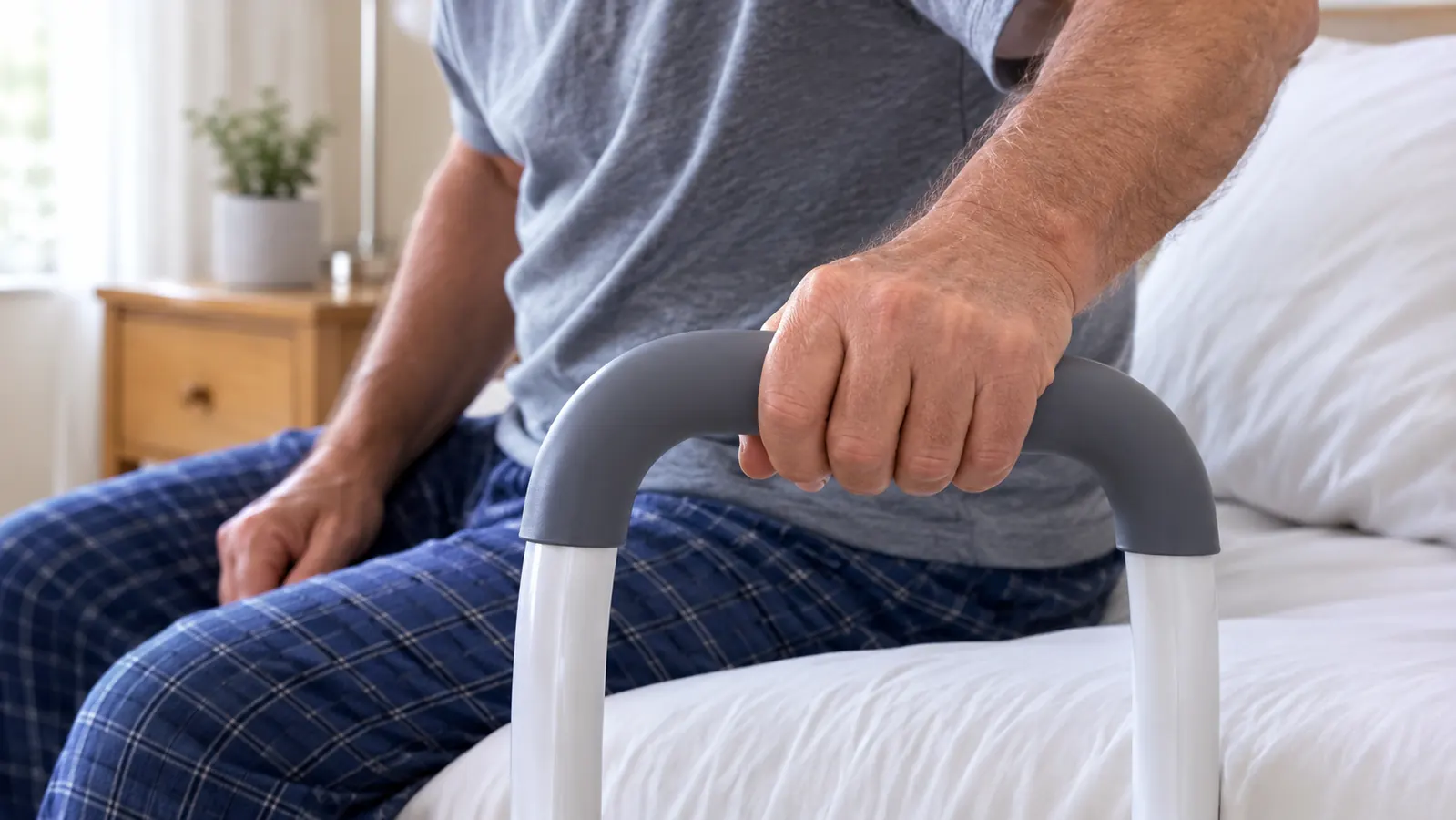
Here is the short answer before I get into the rest of it. The Medline Bed Assist Bar is a handle. A bed rail with legs is a barrier. One gives you something steady to grip at the edge of the mattress so you can stand up on your own terms. The other stands on the floor and runs along the side of the bed to keep a person from going over the edge. If your husband or your mother can get to the edge of the bed but cannot get up from there, you want the handle. If the worry is that they will roll out, you want the rail. Gene and I bought the handle. I will tell you why, and where I think we chose right and where another couple would be making a mistake to copy us.
The January morning that started all of this, my husband Gene sat on the edge of our queen bed for ten minutes and could not push himself up. I was downstairs. He did not call me, which tells you something about a 74-year-old man with a weak right hip. When I finally came up and pulled on his arm, my own left knee let me know exactly what it thought about that. He sleeps on the left side, the side away from the door. We ordered the Medline bar that week, 20 months ago now, and he spent about 20 minutes with me getting it set up. His reading glasses live in the pocket. So does the remote. I looked at rails with legs before we bought, and I did not buy one, and I will be honest with you about why that would have been the wrong call for a different house.
| Medline Bed Assist Bar | Bed rail with legs | |
|---|---|---|
| How it stays put | Slides between the mattress and the frame; the weight of the mattress holds it | Legs reach the floor, so the frame carries the load on its own |
| Beds it fits | Non-articulating twin, full, or queen only | More configurations available, including models for adjustable and hospital-style beds |
| Rolling out of bed | No protection at all. It is a handle, not a rail | A full length rail can act as a boundary along the side of the bed |
| Floor space beside the bed | Nothing on the floor, so the vacuum goes straight under and there is nothing to trip on | Legs stand in the path between the bed and the bathroom door |
| Moving it to another bed | 6.4 pounds, lifts off in one hand and travels in the trunk | A frame built to stay where it is put |
| Reaching things at night | Nylon pocket holds glasses, remote, phone | Usually nothing built in, so the nightstand does the work |
| Setting it up | About 20 minutes for two people, nothing screwed into the floor | More parts, and it occupies its spot once it is built |
| Height | Adjustable to meet the mattress | Varies by model, so measure before you order |
| Best for | Someone who can reach the edge of the bed and needs a steady handhold for the last push to standing | Someone who needs a boundary, or who sleeps in a bed the handle does not fit |
Where the Medline Bed Assist Bar Wins
The thing I did not expect to care about is the floor. Our bedroom is not large, and the walk from Gene's side of the bed to the bathroom door is narrow enough that I count it in steps. A rail with legs stands in that path. The Medline bar never touches the floor. It slides under the mattress and the mattress does the holding. That means nothing to stub a bare foot on at three in the morning, nothing for me to walk around in the dark, and the vacuum goes straight under the bed on Saturday without me moving a stick of furniture. I am 5 foot 4 with a knee that was replaced four years ago, and I drop things. The fewer hard edges at shin height in that room, the better I sleep.
The second thing is that it moves. The whole bar weighs 6.4 pounds, light enough that I can lift it off the bed and carry it downstairs one-handed. We have taken it to a rental cottage for a week and to a hotel for a family wedding, and it rode in the trunk of the sedan next to the suitcase. The height adjusts, so it met the mattress in that cottage as well as it meets ours. Ours is a queen on a plain frame, which is exactly what it is built for. If you have ever tried to move a piece of equipment that was designed to stay in one place, you understand why this matters. Gear that travels gets used. Gear that stays home does not.
The pocket is a small feature that turned into a daily one. Gene's reading glasses and the television remote live in the nylon pocket, which means he is not twisting toward the nightstand at the end of the evening and reaching for something he cannot see. It wipes clean with a damp cloth, which is all the care it asks for. The bar itself is U-shaped, about 27 and a half inches by 14 inches overall and standing just under 44 inches at full height, and it is available in a size that suits a single bed. That is enough to give a hand a place to land without turning the side of the bed into a wall. For a man who needed a handhold and not a fence, that was the whole point.
Where a Bed Rail With Legs Wins
Now the honest part, because I am not going to sell you the thing we bought by pretending it wins everywhere. The Medline bar is held in place by the weight of your mattress. Ours is heavy, it does not budge, and I have leaned on it myself to prove it. But a light mattress, or a thick foam topper over a thin mattress, is a different situation, and a bar can shift under a hard pull. A rail with legs does not depend on the mattress at all. The legs reach the floor and the frame carries the load. If the person using it grabs with both hands and hauls, or leans their whole weight sideways to get up, the rail with legs is the sturdier arrangement. I would not tell you otherwise just because we chose the other one.
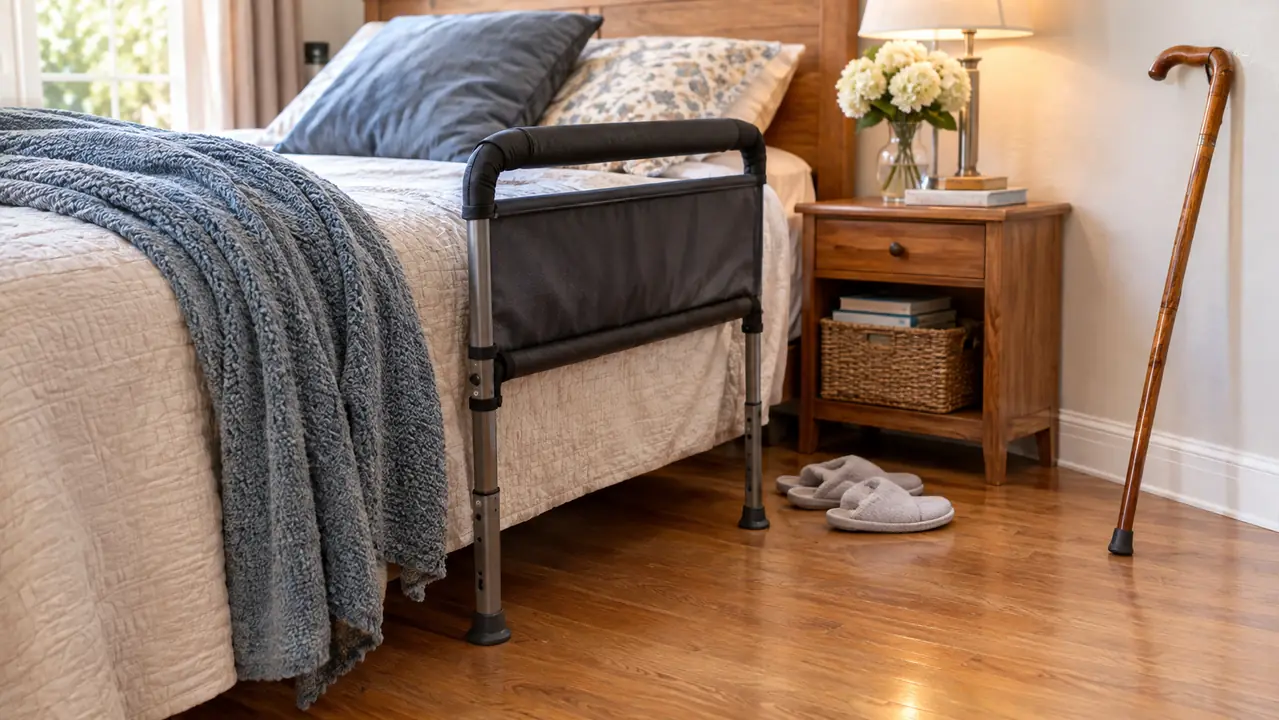
The second place a rail with legs wins is fit. The Medline bar is for non-articulating twin, full, and queen beds, and the manufacturer says so plainly in the product information. That leaves out adjustable beds, hospital-style frames, and any king bed. If you and your husband sleep in a king, or if the head of the bed raises, this bar is not the answer for you and no amount of wanting it to be will change that. Rails with legs are sold in a wider range of configurations, including models made for adjustable beds. Before you order anything at all, measure the bed and read the fit line twice. I have returned more than one thing I was certain would work.
And then there is the job I keep coming back to. The Medline bar is a handle. It is not a rail and it will not keep anyone from rolling out of bed. In our house that is fine, because Gene gets up on purpose. In a house where someone has memory loss, or wakes confused about where the edge of the bed is, or has rolled out before, a handle is not what you need. That is a rail with legs, running the length of the side of the bed with the load going into the floor. A longer rail also gives you a handhold in more than one spot along the way, which helps a person who has to pull themselves along the edge before they are ready to stand.
If the problem is standing up, not rolling out
The Medline Bed Assist Bar is a handle for the edge of the bed: height adjustable, 6.4 pounds, with a nylon pocket for glasses and the remote. It fits non-articulating twin, full, and queen beds. If that describes your bed and your problem, it is the simpler answer.
Amazon Check Today's Price on Amazon →A handle helps you stand up. A rail keeps you from going over. Those are two different jobs, and the one you need depends on which one is happening at your house.
What Neither One Does
Neither of these is a walker, and neither one replaces a conversation with a physical therapist. My therapist is Dana, and she is the person who told me four years ago that a rollator was not a defeat, it was a tool. So I will pass the same thing along to you. If Gene could not sit up on his own, or could not bear any weight once he was sitting, a bar on the side of the bed would not have solved that, and I would have been buying the wrong thing for the wrong reason. A bed handle helps someone who can almost do it alone. That is the entire market for it, and it is a good market. It is just not every person.
One more caution, and I mean this one. A rail is not a restraint, and a rail that traps a confused person is worse than no rail at all. If someone in your house is not steady in their thinking at night, talk to their doctor or their therapist about what is safe before you buy a rail of any kind. I am not a nurse and I am not a therapist. I am a retired elementary school music teacher in Dayton who has learned to ask before she buys. That habit has saved me more money than any sale ever has, and it has kept Gene out of the emergency room twice.
Who Should Buy Which
Buy the Medline Bed Assist Bar if the person can get to the edge of the bed, sit up, and put their feet on the floor, and only needs something steady to pull against for the last push to standing. Buy it if the bed is a non-articulating twin, full, or queen. Buy it if the bedroom is small, if the floor needs to stay clear, or if the bar has to travel to a hotel or a second home. Buy it if you want the pocket, because a man who cannot see his glasses at night will thank you for it. Twenty months in, Gene still uses it every single night, and my only regret is that we let him sit there stuck through a whole January morning first.
Buy a rail with legs instead if the bed is adjustable, if it is a king, or if the frame is hospital style. Buy it if someone has rolled out or might, or wakes at night not knowing where the edge of the bed is, or needs a boundary rather than a handhold. Buy it if the person using it pulls hard with both hands and you want that load going into the floor rather than into the mattress. And buy it knowing it will live in that spot, because it is not the kind of thing you fold up and carry to a rental cottage for the week. Both products are honest answers to different questions. The trouble starts when someone buys the answer to the wrong question.
And if you are not sure which of those paragraphs describes your house, here is the free version of this advice. Watch them get out of bed tomorrow morning. Do they get to the edge on their own? Do they wobble once they are sitting? Do they reach for the nightstand, or the wall, or you? That is the information you actually need, and it costs nothing but ten quiet minutes. Then call the therapist and ask. Dana has talked me out of two purchases I was certain about, and she was right both times. The right product in a house is worth more than the most popular one in a review.
The one we still use, twenty months on
Height adjustable, 6.4 pounds, a pocket for the glasses and the remote, and no legs standing in the path to the bathroom in the dark. If your bed is a non-articulating twin, full, or queen and the problem is standing up, this is the handle.
Amazon Check Today's Price on Amazon →