

Gene sat on the edge of our bed for ten minutes that January morning. Not resting. Working at it. He would lean forward, put a hand on his right knee, rock once, and sit back down. On the third try I walked around the bed and pulled him up, and my own knee reminded me about it for the rest of the day. That afternoon I ordered the Medline Bed Assist Bar. Twenty months later it is still on his side of the bed.
Here is what I want to say before anything else. The bar is a handle. It is not a railing, it will not keep anybody from rolling out of bed, and it will not make a weak hip strong. What it does is give your hand something that does not move while you do the work of standing. That sounds small. On the mornings when it works, it is the difference between getting up on your own and waiting for somebody to come help you. Below is the order we did things in, and the order I would do them again.
Give your hand something that does not move
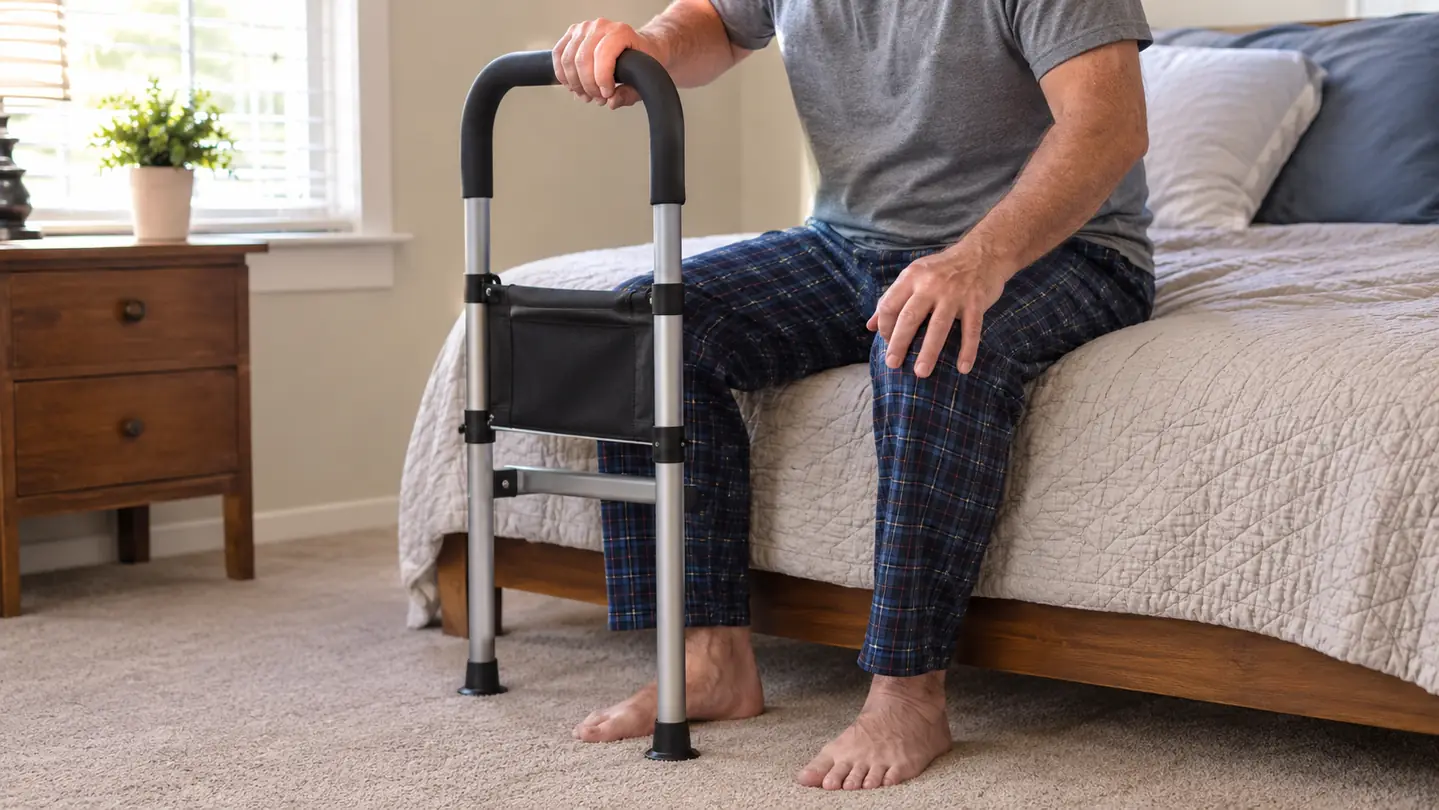
Twenty months on Gene's side of the bed. Height adjustable, a nylon pocket for the remote and the reading glasses, and a handle that stays where you put your hand. Check the current price and the bed sizes it fits before you order.
Amazon Check Today's Price on Amazon →Step 1: Call your physical therapist before you buy anything
I called Dana, the physical therapist who got me through my knee replacement, before I clicked the button. She did not tell me to buy a bar or not to buy one. What she told me was to watch Gene get out of bed for three mornings running and write down what actually failed. Was he unable to push? Was he unable to lean forward? Was he afraid of falling? Those are three different problems and they do not have the same fix.
That is worth doing even when you are sure you already know. I was sure it was a strength problem. My notes from those three mornings were humbling to read back. Monday he was up in under a minute and made it look easy. Tuesday it took four minutes and I heard him say something under his breath. Wednesday he did not get up at all until I came around the bed. Three mornings, three different answers, and none of them was the answer I had already decided on. It was partly a balance problem. The bar helped with the balance part and did nothing at all for the strength part. Dana also asked whether Gene had been checked for the dizziness he had been having when he stood up. He had not. He has now, and that conversation mattered more than the purchase did.
I am not a nurse and I am not a therapist. I taught elementary school music for thirty one years and I can tell you which hymns a congregation can actually sing. So when I say ask yours, I mean it, and I mean before you spend anything and before you change anything about how he gets out of bed in the morning.
Step 2: Measure the bed, because this bar only fits some of them
The Medline bar is made for non-articulating twin, full, and queen beds. Ours is a queen on a plain frame that does not adjust, which is exactly what it wants. If you have one of the beds that raises the head or the foot with a remote, this is not your product and no amount of adjusting will make it one. Check that before anything else, because it is the one thing you cannot fix later.
Then measure two things. The height from the floor to the top of your mattress, and how far your hand naturally hangs when you sit on the edge. The bar is height adjustable, and the whole point of that adjustment is that the handle ends up where your hand already goes. Dana's rule was that you should be able to rest your hand on it with your elbow slightly bent, not stretched out straight and not crumpled up against your side. Use a real tape measure and write both numbers on the back of the receipt, because eyeballing it is how a person ends up with a handle three inches lower than they wanted. Gene held the tape and I read it out, and I still got the first setting wrong. It took two tries before the handle landed where his hand already went.
The other measurement nobody mentions is the gap between the bed and the wall or the nightstand. Ours is about a foot on Gene's side, which is enough room to slide the flat part under the mattress without moving furniture around. If yours is tighter than that, measure before you order and you will save yourself a return and a trip to the post office.
Step 3: Install it with two people, and put your weight in the right place
Gene and I did the installation together in about twenty minutes, and I would not want to have done it alone. The flat piece goes under the mattress and the U shaped handle comes up at the side of the bed. The bar itself weighs 6.4 pounds and the footprint is 27.5 inches by 14 inches, so it takes up less room under the mattress than I expected. The overall height is 43.75 inches, which matters when you are working out where the handle will land on your own bed.
The one thing to get right is that this is meant to be held, not leaned on with your whole body. It is a support for getting in and out. If Gene put his full weight against it sideways, that is not what it is built for and I would not let him do it. It is a handhold. Treat it like the grab bar in a bathroom, not like the side of a crib.
Set the height with the person sitting in the bed, not standing next to it. He sat on the edge, I held the handle at the height that let him grip it with a soft elbow, and then I tightened it down. The first night I had it an inch and a half too high, which I did not know until I watched him reach up for it instead of down. Reaching up is a small thing that turns into a shoulder ache by the end of the week. We lowered it the next morning before breakfast, and it has not moved since apart from the one time he changed to a thicker mattress pad, which took five minutes and one more pair of hands.
Step 4: Practice the getting up sequence, in the order your therapist gave you
This is the step people skip, and it is the one that decides whether the bar helps or just sits there. Buying the thing is easy. Using it the same way every morning is a habit. Dana's sequence for Gene was this: roll to the side, bring the knees up and swing both legs over the edge, sit for a count of five and let the head catch up, then nose over toes, lean forward, one hand on the bar, push through the legs, and stand up straight before taking the first step.
The first week he did it with me standing next to him. Not touching. Just there. I stood at the foot of the bed, out of reach, and counted to five out loud with him, because he kept skipping the sitting part. Skipping the sitting part is what makes a person dizzy, and dizzy at the edge of a bed is how a hip gets broken. By Thursday he was doing the count himself without being reminded, which is how I knew it had turned into a habit instead of a performance for my benefit. What the bar changed, and this surprised me, was the hesitation. He stopped doing the thing where he would rock three times and give up and sit back down, because once his hand was on something solid he could commit to the push. The strength did not change in a week. The willingness to try did.
If nobody has ever taught you a sequence, ask for one. Do not build it out of a video you watched at midnight, and do not let a spouse build one either. Two of us in this house have had knees and hips worked on and neither of us is qualified to teach it to anybody.
Step 5: Load the pocket, then check the bar once a month
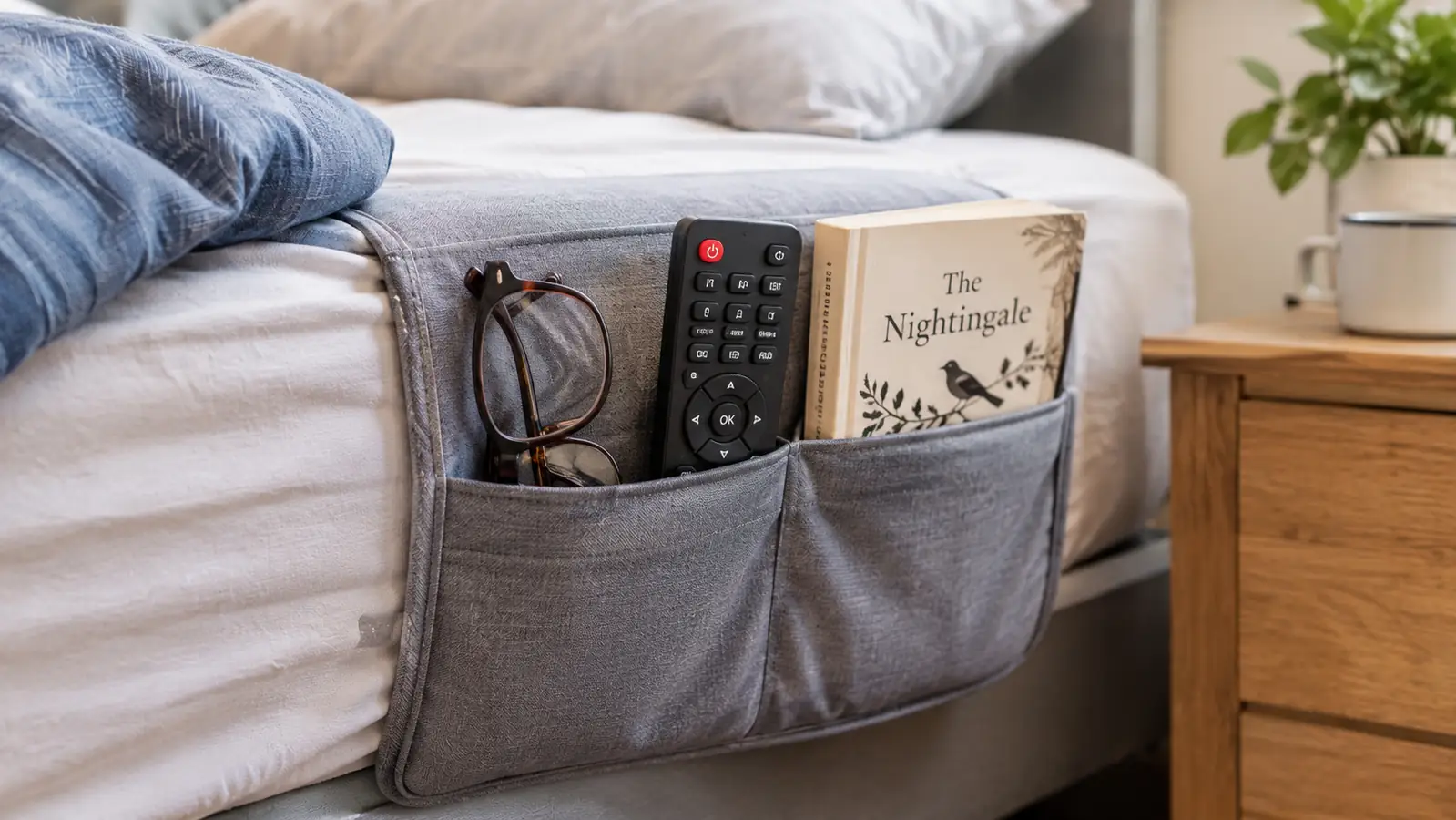
The Medline bar comes with a nylon storage pocket, and that pocket turned out to matter more than I expected it to. It hangs on the inside of the handle where his hand already is, which is the only reason it gets used at all. Gene's reading glasses go in it first thing at night and the television remote goes in it last. The remote is the thing. Before, he would twist around to reach the nightstand and I would watch his whole balance go with him. Now he does not have to turn at all, and the twisting was half the problem.
Once a month I do a two minute check. I grip the handle and shake it to be sure nothing has worked loose, I look at where the flat part goes under the mattress, and I wipe the whole thing down with a damp cloth. That is the entire care routine. No products, no scrubbing, no taking it apart. It has held up fine and we have replaced nothing on it.
And once a month I ask him the question I do not enjoy asking. Is it still helping, or are you just used to it being there? Because a bar can turn into furniture. As long as he is using it to stand up and not leaning on it to stay upright during the day, it is doing its job and earning its place.
What Else Helps
The bar is one piece of a morning, not the whole morning. Three other things did as much for us and none of them cost much. A lamp you can reach without getting out of bed, so nobody swings their legs out into the dark. A clear path from the bed to the bathroom door, with no laundry basket and no shoes in it. And slippers with a back on them, because a backless slipper sliding off a heel is how a person ends up on the floor at two in the morning.
Gene's cane stands next to his chair during the day and comes to the bedroom at night. His is the HurryCane, the one that stands up by itself. He refused every cane until our anniversary dinner, when a borrowed one slid off the table edge and hit the floor and he had to ask the waiter for it. He carries it in his left hand, opposite the weak hip, the way Dana showed him.
I keep the reacher by the kitchen door for whatever falls, and I do not trust it with anything heavy or breakable. That is my knee talking, not his hip. Between the bar at the bed, the cane at the chair, and the reacher at the door, most of the bending and reaching in this house got smaller. Smaller is what we needed. Not gone. Smaller.
What the bar changed was the hesitation. Gene stopped rocking three times and giving up, because once his hand was on something solid he could commit to the push.
Start with the morning, not with the whole house
You do not have to fix everything at once. One solid handhold at the edge of the bed is where most people should begin. Height adjustable, a pocket for the remote and the glasses, and a handle that stays put. For non-articulating twin, full, and queen beds. Check today's price on Amazon.
Amazon Check Today's Price on Amazon →