
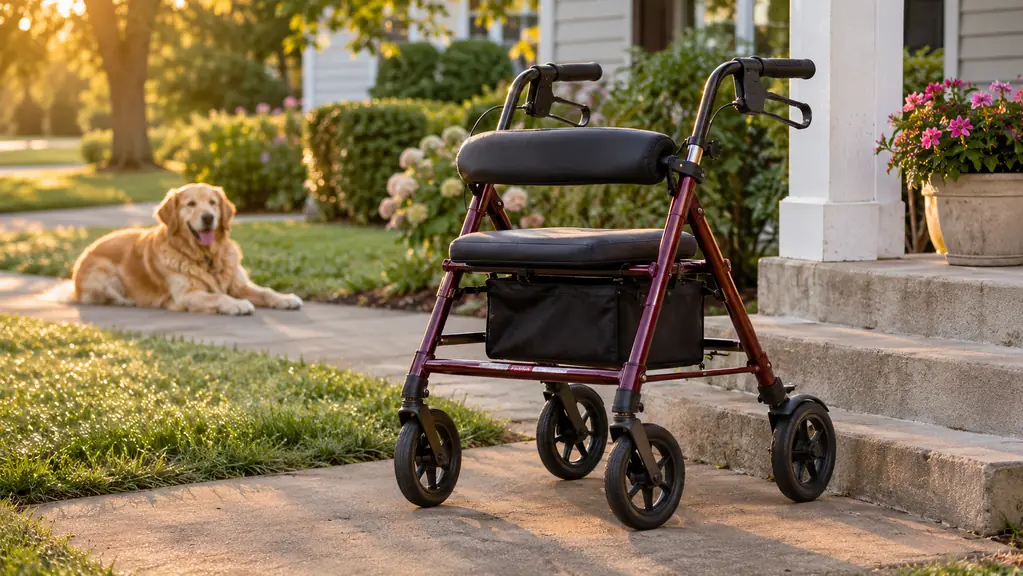
Nobody warns you that the hard part is not the walking. It is the deciding. Four years ago I stood in my kitchen the week before my left knee replacement, phone in one hand and a catalog page open on the counter, arguing with myself about whether ordering a rollator meant I was giving something up. My physical therapist, Dana, had suggested it the way she suggests everything, plainly, and I had nodded and then spent two days not ordering it. So here is the version I wish somebody had handed me: the weight of the thing, the width of it, the eleven months my husband Gene would not touch it, and the specific jobs where a Drive Medical rollator is the wrong tool entirely. I am not a nurse or a therapist and I do not play one here. I am a 71-year-old retired elementary school music teacher in Dayton, Ohio, and I have owned this rollator for four years and still own it today.
The Quick Verdict
A steady, plain, well-built rollator that gave me my half mile back after surgery. Buy it if you can lift 20 pounds into a trunk and your narrowest doorway is wider than 21.5 inches.
Amazon Check Today's Price →Four years, one knee replacement, and one rollator that stayed in the garage
This is the same model I bought the week before my surgery on Dana's advice. Measure your bathroom door first, then go look at today's price.
Amazon Check Today's Price on Amazon →How I Have Actually Used It
I bought it four years ago, the week before my knee replacement, on Dana's advice. For the first three months I used it every single day, mostly on the main floor, kitchen to living room to the back porch, and out to the mailbox at the end of the walk. By month four I was doing the neighborhood loop, about half a mile, with one rest on the seat at the corner. By month six I did not need it around the house anymore. That last sentence is not a knock on the rollator. A good mobility aid is often a temporary tool, and this one made the temporary part shorter than I expected it to be.
Since then it lives in the garage and comes out for long days. The other person who uses it is Gene, my husband of 46 years, who is 74 and has a weak right hip. He refused it for months. Then 14 months ago at the county fair his hip gave out halfway around the livestock barns and I walked all the way back to the car to get it. He has used it for the fair and the farmers market ever since, and we reset the handle height between us with the lever, him first and then me. It is one rollator, shared, and that has worked better than either of us expected.
The way I test anything is my choir rehearsal. I sing alto at church on Sundays, and standing through a long rehearsal is the measure I use for my knee. The rollator does not go inside the church with me. It stays in the car for the walk from the far end of the lot, which is exactly the kind of short, stupid distance that used to end my whole evening.
There is one more piece of the usage picture nobody puts in a review, so I will. It does not get used in the rain, and that is our choice, not a fault. Wet pavement and a knee that has been replaced is a combination I do not gamble with, and the seat pad is not something I want soaked before I need it. So on a wet Sunday the rollator stays in the garage and I take the shorter route from the side lot, and that is the honest shape of four years with it: it is a fair weather tool in our house, and it has never once been asked to be more than that.
What Nobody Tells You: Twenty Pounds Is a Real Number
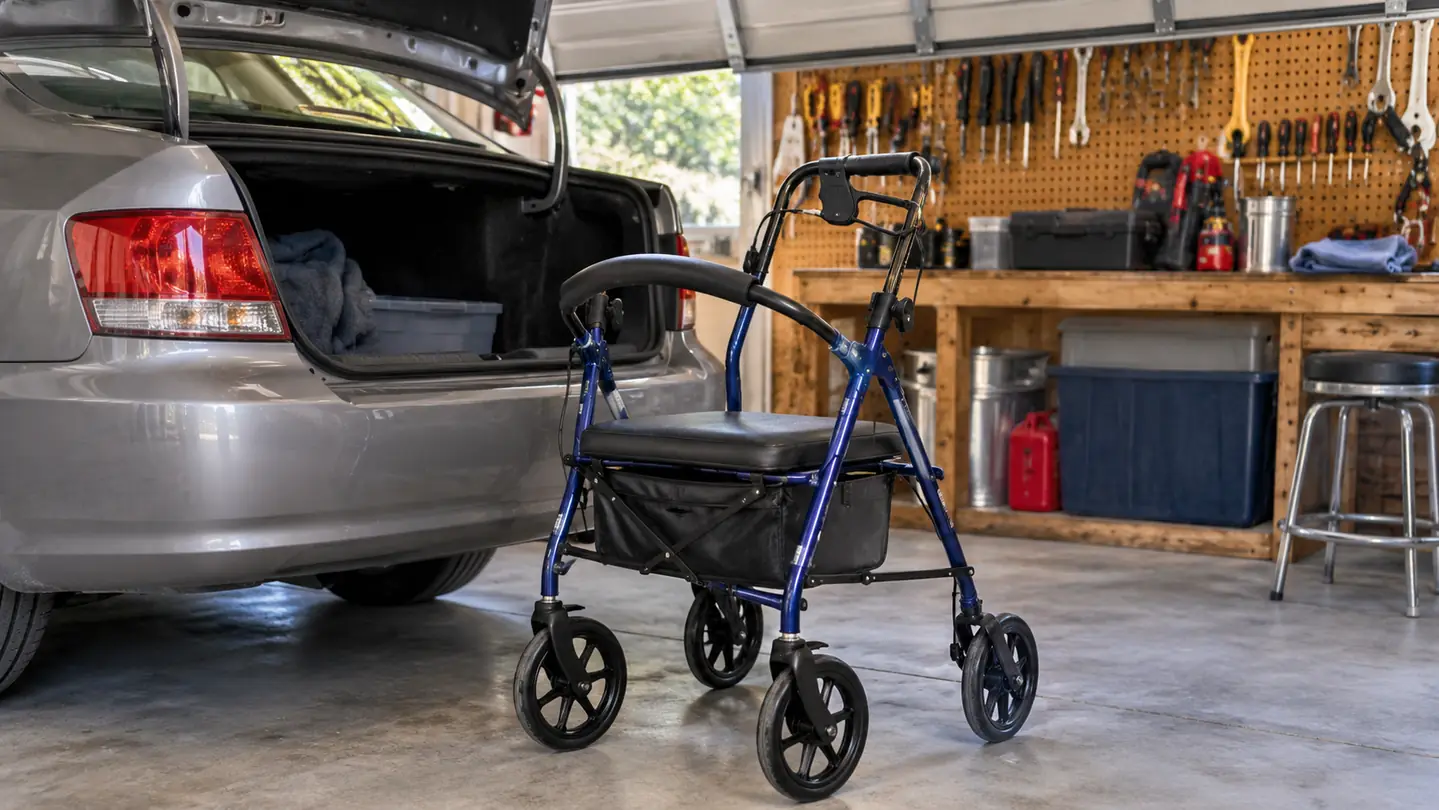
The listing says 20 pounds and your eye slides right over it. Twenty pounds does not sound like much until you are lifting it at an angle into the trunk of a four-door sedan with a knee that has opinions. This is my main complaint and it has not softened in four years. I can lift it. I do not like to. On a Sunday morning, when Gene is already in the passenger seat and I am at the wheel, I am the one who has to wrestle it into the back, and I have learned to do that before I sit down, not after.
There is a workaround, and it is the back support. The back support folds up and lifts off, which takes a couple of inches off the profile and makes the whole thing easier to slide in. The frame is alloy steel, which is where the weight comes from and also why nothing on it has loosened in four years. If you cannot lift 20 pounds, or if the person who will be doing the lifting is not you, say that out loud before you order. That one question is worth more than any star rating on the page.
I will put a date on it, because vague complaints are worthless. The worst lift of the last year was a Tuesday in October, the morning after Gene had been on his feet all day at the market. I had the trunk open, the seat was wet from dew, and I got it up on the second try with my hip doing work I did not want it doing. Nothing bad happened. But I stood there in front of the garage afterward and thought, this is the thing I would change if I could change one thing. Not the walking. The lifting.
Measure Your Narrowest Doorway Before You Order
This is the number I wish I had read first. The Drive Medical rollator is 21.5 inches wide. That is fine for a hallway and fine for the front door. It is not fine for our downstairs bathroom, which has a narrow older door, and it is a nuisance in the kitchen when the chairs are pulled out. The frame is 25.5 inches front to back as well, so it does not tuck against a wall the way a cane does. It takes up real floor space and it does not apologize for it.
We have three steps up to the front door. The rollator does not climb them. Somebody lifts it, and that somebody is usually Gene, which is a little funny given that he is the reason it comes out of the garage at all. Get a tape measure and check your bathroom door and any threshold you cross every day. If the size is going to bother you, it will bother you every single day, and no feature on the box makes up for that.
We measured ours the second week, after I got tired of turning it sideways. Hallway: 34 inches, plenty. Front door: fine. Downstairs bathroom: 22 inches at the frame and about 21 at the door itself once you account for the hinge side. That half inch is why the rollator parks in the hall while I go in holding the wall. It is not a tragedy. It is a detail I would have wanted to know in advance, and I am telling you now so you can walk your own house with a tape before the box arrives.
The Seat Is for Resting, Not for Sitting
People see a seat and imagine parking themselves in it for an afternoon. That is not what it is. The seat is a rest stop. At the corner of our loop I sit for three or four minutes, take the load off the knee, and get up. At the fair last fall I sat for eleven minutes while Gene went for a lemonade, and by the end of it my back had had enough. It is a place to catch your breath, not a chair.
Where it earns its keep is on the days when you have misjudged the distance. The half mile I do now is possible because I know there is a place to stop at the halfway point. That is the whole difference between a walk I will take and a walk I will not. If you have ever turned around early because you were not sure you would make it back, you know exactly what I am describing and I do not need to sell it to you.
The Handle Height Has a Ceiling
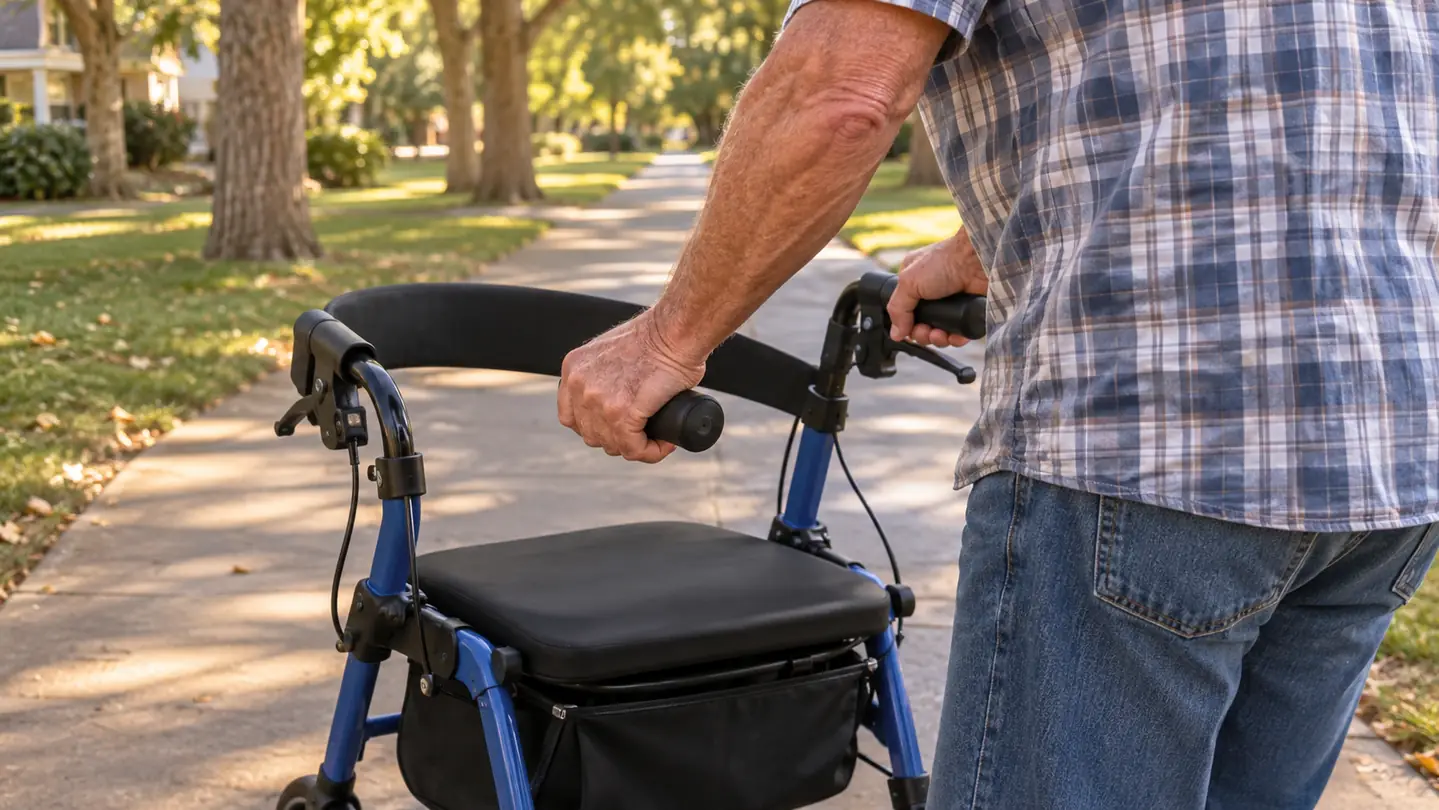
The handle height adjusts with a lever and tops out at 35 inches. The listing recommends a minimum user height of 59 inches. At 5 foot 4 I have room to spare. Gene is 5 foot 10, and he sits near the top of that range, close enough that we checked it twice before we trusted it. If someone in your house is over six feet, have them stand with it before you buy. A rollator that is an inch too low will have them hunched, and a hunched walker is a walker who quietly stops using it.
The lever itself is easy, which matters more than it sounds. We change the height every time we swap, usually in a parking lot with the trunk still open, and neither of us has to fight it. The frame carries a limited lifetime warranty and the weight capacity is 350 pounds. I mention both because people ask me at the farmers market whether it is sturdy, and the honest answer is that it has held two adults, one at a time, for four years without a wobble.
What I would tell Gene if he were listening, and he is not: he should have been at the top of that range and no higher. We set it once with him standing and me reading the numbers, and then we put a strip of masking tape above the lever so neither of us drifts out of our own setting. It sounds fussy. It has saved us an argument at every single outing, because there is no guessing and no adjusting it by feel in a parking lot with the sun in your eyes.
About the Wheels, and Where This Thing Stops Working
The wheels are 7.5 inches. On a sidewalk that is enough. It takes the seams, the cracked squares, and the lip at the end of a curb cut. On gravel or soft grass it is work. We go to the fair and the market, both paved, and it is fine there. The one time I tried it on the grass at a church picnic I turned around and went back to the pavement. That is not a defect. It is just what a 7.5 inch wheel does, and pretending otherwise would be unkind to you.
Here is the plain truth about this machine: it is a pavement tool. Sidewalks, paved paths, the smooth concrete of the farmers market, the blacktop of a church lot. It is not a trail device and it is not a lawn device. I have watched people buy equipment like this and then decide the equipment is bad because they took it somewhere it was never built to go, and that is a disappointment you can avoid entirely by being honest with yourself about what your own neighborhood is made of before the box arrives.
The rating on this listing is 4.6 out of five across more than 51,000 reviews, and I understand why. The Drive Medical rollator is a plain, sturdy, unglamorous piece of equipment that does what the box says it does. What 51,000 reviews cannot tell you is whether your trunk is too high, your bathroom door too narrow, or your pride too stubborn for the first week. Mine was. Dana was right and I was slow, and that is the most common version of this story I know.
The First Week Is the Worst Week
The equipment is the easy part. The first week is the hard part. I remember standing in the garage with it four days after surgery, feeling like I had been handed a sign to wear around my neck. My neighbor waved from her yard and I wanted to explain myself, which is a ridiculous thing to want and I wanted it anyway. By the second week I had stopped explaining. By the second month I was using it to carry a cup of coffee from the kitchen to the porch, and I had stopped thinking about it altogether.
If you are the one ordering for somebody else, this is the part to be gentle about. Gene said no for months, and I did not push after the second conversation. What I did instead was leave it in the garage where he could see it, and let the county fair do the arguing. When his hip gave out he came and found me, and I went and got it out of the car, and nobody said a word about all those months of no.
What I Liked
- The seat gives a real rest on a long walk, which is what made my half mile possible again
- Alloy steel frame with a 350 pound weight capacity that has not loosened in four years
- Back support folds up and lifts off, so it slides into a sedan trunk more easily
- Height adjustment lever is quick enough that Gene and I swap it in a parking lot
- Limited lifetime warranty on the frame
Where It Falls Short
- 20 pounds is heavy to lift at an angle into a car trunk, and that is my main complaint after four years
- 21.5 inches wide and 25.5 inches deep, so it does not fit a narrow older bathroom door
- 7.5 inch wheels handle sidewalk seams but not gravel, soft grass, or a rough path
- Handle height tops out at 35 inches, which is tight for anyone over six feet
- The seat is a rest stop, not a place to spend an afternoon
The half mile I do now is possible because I know there is a place to sit at the halfway point. That is the whole difference between a walk I will take and a walk I will not.
Who This Is For
This is for someone coming off a knee or hip replacement who needs to keep walking and needs a place to stop. It is for a household where two people of different heights will share one unit, because the lever makes that genuinely easy. It is for the person who wants a seat, a steel frame, a 350 pound capacity, and does not mind lifting 20 pounds into a trunk. And it is for the family member doing the ordering, honestly, because the ordering is usually the hardest part of the whole thing. If that is you, this Drive Medical model is the one I would put in front of your person and let them stand next to. Dana suggested it to me plainly and it took me two days to listen. Ask your own physical therapist or doctor before you change anything about how you walk, and ask them about the height, not just the model.
Who Should Skip It
Skip it if you cannot lift 20 pounds and nobody in the house can lift it for you. Skip it if your narrowest daily doorway is under about 22 inches, because you will fight it every morning. Skip it if you need something for grass, gravel, or a gravel path out to the mailbox, since the 7.5 inch wheels will make you work. Skip it if what you need is a device that keeps somebody from falling, because that is a different piece of equipment and this is not it. And skip it if the person who needs it has already said no, at least for now. Gene said no for months. The Drive Medical rollator sat in the garage and waited, and when he was ready it was there. That is the most honest thing I can tell you about the whole four years.
If you are ready, this is the one that waited in my garage for four years
Twenty pounds, a seat at the halfway point, and a handle that adjusts for two people. Measure your bathroom door, then go look at today's price.
Amazon Check Today's Price on Amazon →