

Gene fought the idea of a cane for a long time before he would hold one. That is the honest version. He had a weak right hip and a wobble that showed up most on stairs and in parking lots, and every time I brought it up he said he was fine, and then he would put a hand on the wall going down the hall and hope I did not notice.
What finally changed it was not an argument or a scare. It was an anniversary dinner. A plain cane we had borrowed slid off the edge of the table and clattered onto the floor, and he had to ask the waiter to pick it up. He said, quietly, never again. The next week I ordered him a HurryCane Freedom Edition because it stands up on its own, and that one detail, the standing up, was the whole reason he agreed. He has carried it in his left hand every day since. What follows is how he actually learned to use it, and what our physical therapist Dana walked him through, and the parts we got wrong first.
The cane that stands up when he lets go of it
Gene would not carry a cane until he found one that stayed upright on its own. Folds to 13.7 inches, adjusts from 30.5 to 37.5 inches, 16 ounces.
Amazon Check Today's Price on Amazon →One thing before any of this: I am a retired elementary school music teacher, not a doctor and not a physical therapist. I have a left knee replacement that is about four years old and a husband with his own set of problems, and that is the whole of my qualification. Dana is the one with the training. Ask yours before you change how you walk, especially if you have had a fall, have numbness in your feet, or have been told you have a balance disorder. A cane helps with some things and does nothing for others, and only someone who can look at you can tell which is which.
Step 1: Get the height right before you take a single step
This is the step people skip, and it is the one that decides whether the cane helps or hurts. Most of us grab whatever cane is around and go. Gene did, with a borrowed one, for two days, and his shoulder ached.
The measurement Dana gave us: stand up straight in the shoes you actually wear, arms at your sides, and let the cane hang. The top of the handle should land at the crease in your wrist, roughly level with the bump on the outside of your hip. Not your waist. Not your fingertips. The wrist crease. Gene is 5 foot 10, and on the HurryCane that put him a good bit up the adjustment range, well above the 30.5 inch bottom. I am 5 foot 4 and mine sits lower. That is why the range matters.
The HurryCane adjusts between 30.5 and 37.5 inches, and it locks by folding and unfolding rather than by a push button, which took Gene a couple of tries to trust. Here is how to check it: stand it beside you, put your hand on the handle, and let your arm hang relaxed. If your elbow is bent like you are carrying a shopping bag, it is too short. If you have to reach down or lean to the side, it is too long. You want a soft, slight bend, maybe fifteen degrees, and you want your shoulders level.
Then reset it if someone else in the house uses it. We keep a mental note of where Gene's height is, and when I move it for company I put it back. A cane that is two inches off is worse than no cane, because you will lean.
Step 2: Put it in the hand across from your weak side
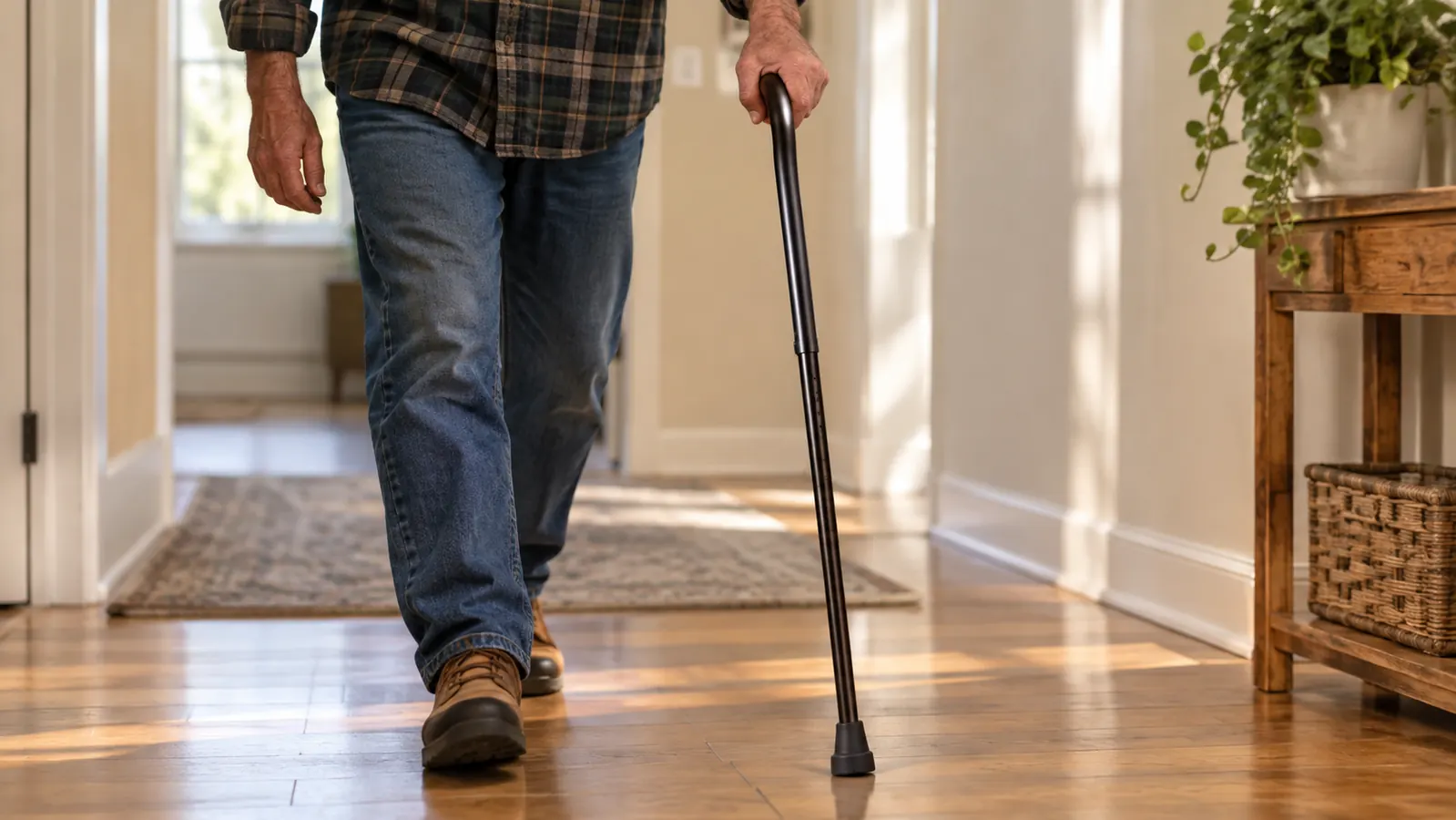
Gene had this backwards for a week. His weak side is the right hip, and his instinct was to hold the cane on the right, because that is where the trouble is. That is exactly wrong, and it is the single most common mistake I see in the church parking lot on Sunday.
The cane goes in the hand opposite the weak leg. For Gene, left hand, weak right hip. The reason is simple once you picture it: your cane and your weak leg move together, so the cane is on the ground taking load at the same moment your bad side is bearing weight. Hold it on the same side and you are just decorating the room.
Because Gene is right-side weak, the cane alternates with his right foot. Cane and right foot forward together, then left foot. If your weak side is your left, flip it. If both sides are about the same, which is common as you get older, ask your physical therapist which hand to start with, because there is a right answer for your body and it is not always the one that feels natural.
Step 3: Learn the walk pattern in your own hallway
Do not practice in a parking lot. Practice in a hallway with a wall on one side and nothing to trip over.
The pattern: cane and weak leg forward at the same time, cane tip landing a comfortable stride ahead, then step through with the strong leg. It feels strange for about three days. Then it stops feeling like anything, which is what you want.
Two details Dana drilled into Gene. First, plant the cane, do not tap it. It is there to take weight, and if you stab at the floor you are not loading it. Second, look ahead, not down at your feet. Looking down shifts your weight forward and makes the wobble worse. He counted steps out loud for the first week, which sounds silly and worked, because it kept his chin up.
We did about ten minutes a day, twice a day, for a week, in our front hall. By the second week he was using it for the walk out to the mailbox, which is where the three steps up to our front door live. Steps are their own project, and I will get to that.
The cane goes in the hand opposite the weak leg. Gene had it backwards for a week, and his shoulder told him so before anyone else did.

Step 4: Rehearse the stairs and the curbs before you need them
Stairs are where people get hurt, and the rule is the same one your mother told you about a railing. Going up, the strong leg goes first. Going down, the cane and the weak leg go first. Say it out loud until it is automatic: up with the good, down with the bad.
Gene's version, on the three steps up to our front door going down: cane down onto the step below, weak right foot down to meet it, then the left foot. Coming up, left foot up first, then the cane and the right foot together. He puts his free hand on the door frame coming up, and I do not tease him about it, because a hand on a wall is a second point of contact and there is no prize for not using one.
Curbs are the same idea with worse timing. Step down with the cane and the weak leg, then the strong leg. Step up with the strong leg first. Do it slowly and let the person behind you wait. The one thing I would tell anyone: do not do a curb while carrying something in your other hand. Set the bag down. Gene learned that one at the farmers market with a paper sack of tomatoes, and we nearly lost the tomatoes and a good deal more.
Our door thresholds are another matter. The HurryCane has a wide base, four little feet instead of one tip, and that base gives it the stability that made Gene willing to use it. It also catches on the metal strip at the bottom of our kitchen doorway now and then. So we lift it slightly over thresholds rather than dragging it. If your house has a raised lip at the bathroom door, walk it once with someone nearby before you do it alone.
Step 5: Build the standing-up habit, and know what the cane will not do
A cane steadies you when you are already upright and moving. It is not much help getting out of a deep chair, and it is no help at all getting out of a car. That distinction saved us a lot of frustration once we understood it.
For chairs, the trick Dana gave Gene is to scoot to the front edge, get both feet flat under him, and push up through his legs and the chair arms, with the cane in his hand but not yet weighted. Once he is up and steady, the cane goes down. If he tries to pull himself up on the cane, it slides, and the base on a smooth kitchen floor will skitter. He learned to set the base flat and let it settle before leaning on it.
For the car, the cane stays out of it, because there is nothing to plant it on. That is a different tool and I have written about it separately. Out of a sedan seat, what worked for Gene was the car cane that slides into the door latch, used only when the car is parked. Out of bed, it was the bed bar on his side. The cane is for walking. Making it do the other jobs is how people fall.
And the honest limits. Gene's cane is 16 ounces of aluminum and it does wonders for a wobble. It is not a walker. On a long day, the county fair or a full afternoon at the mall, he uses our rollator and leaves the cane at home, because a cane asks your legs to do the work and the rollator does not. The cane also does not stop a fall that has already started. It reduces the chances. That is the whole claim, and it is worth making.
What Else Helps
Three things beyond the cane itself, all cheap.
First, shoes. Gene wore a pair of soft-soled slip-ons for years because they were easy, and they were part of the problem. A firm sole with a back to it changed how steady he felt before we changed anything else. Second, light. Half of the wobbles I have watched happen in a dim hallway at night or on a porch at dusk. We put a lamp at the top of the stairs and a motion light outside the front door, and the number of stumbles went down without anyone doing any exercises.
Third, and this is the one I would underline, ask Dana or your own physical therapist what to practice. A cane compensates. It does not strengthen anything. Gene does a short set of standing exercises most mornings, holding the kitchen counter, and those are what actually improved his hip over the past two years. The cane bought him the confidence to do them without a hand hovering behind him. That is a good trade. It is not the same thing as getting better, and anyone who tells you a cane alone will fix your balance is selling something.
If you are still deciding whether a freestanding cane is the right shape of cane for you at all, I have written about how ours has held up over two years of daily use, and about how it compares with a plain folding cane, and there is a plain list of what a cane like this genuinely does for balance if you want the short version. All three are on this site. Start with the one that sounds like your situation.
Sixteen ounces, stands on its own, and Gene finally carries it
The one detail that got a stubborn 74-year-old to use a cane every day: it does not fall over when he sets it down. Folds to 13.7 inches for the car.
Amazon Check Today's Price on Amazon →