

Nobody warns you that the hard part of knee surgery is not the surgery. It is week four, when the swelling is down and the staples are out, and every person you meet says the same three words: just keep walking. As if distance were something you could decide to have.
I had my left knee replaced four years ago, at 67. Softball wore it out. I quit playing at 58, which turned out to be about nine years too late. I live in a two story house in Dayton, Ohio, with three steps up to the front door and the bedroom upstairs, and in those first weeks I could not get to the mailbox without stopping to hold onto something. What moved me past that was not willpower. It was a Drive Medical rollator, a physical therapist named Dana, and a rule about distance that I did not like one bit at first.
I am not a doctor, a nurse or a physical therapist, and nothing here is medical advice. Dana is the physical therapist. She is the one who told me what to do and when to stop, and I will say the same to you plainly: ask yours before you change anything about your own routine. What I can tell you is what she and I worked out with a four wheel rollator over about six months, in a house with stairs, on a sidewalk with a crack in it, and in a church parking lot on a Sunday morning.
The rollator I bought the week before surgery, and still own
Dana told me to have a four wheel rollator with a seat in the house before the operation, not after. This is the one I bought. The Drive Medical rollator walker with seat: steel frame, 7.5 inch wheels, fold up removable back support, 350 pound weight capacity, 20 pounds. Four years old now and still in my garage.
Amazon Check Today's Price on Amazon →Here is the order that worked for me, and the reason each step sits where it does.
Step 1: Set the handle height before you take a single lap
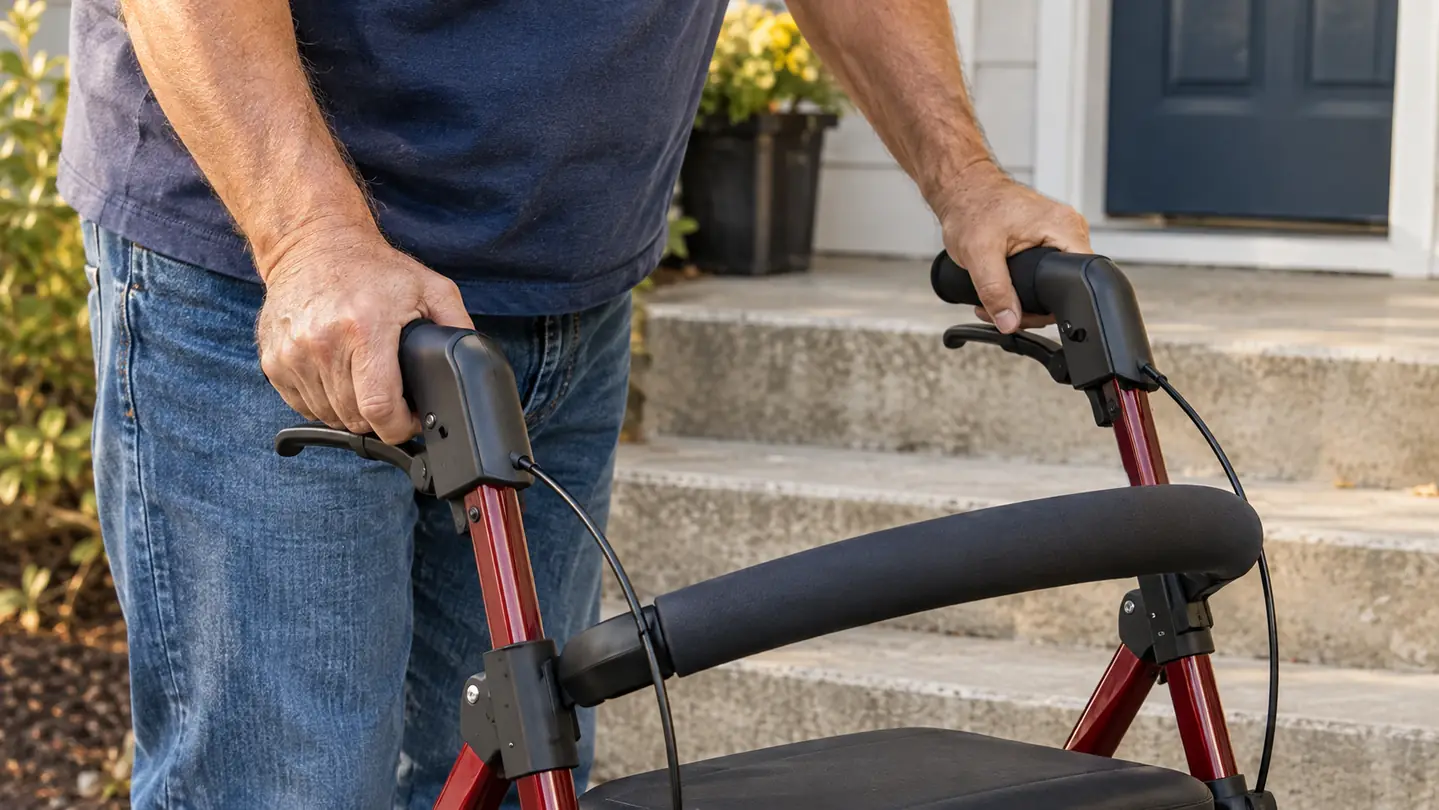
The first thing Dana did with my new rollator was not let me walk with it. She put it against the wall and adjusted the handles. There is a height adjustment lever on each side, and the handles top out at 35 inches. The listing recommends a minimum user height of 59 inches, and at 5 foot 4 I clear that by five inches, which told me right away this was not equipment I would outgrow in either direction.
Set the handles so they land at the crease of your wrist when you stand up straight with your arms hanging down. Your elbows should keep a slight bend when your hands are on them. If you are reaching down, the handles are too low, and you will round your shoulders and shuffle. If you are reaching up, they are too high, and you will lean back. I started one notch lower than Dana set it, because it felt more natural to me. I was wrong. Within a week my shoulders ached. I moved it up and the ache went away.
One more thing about height. Gene is 5 foot 10 and I am 5 foot 4, and we share this one rollator. He uses it for long outings now, the county fair, the farmers market. We reset the handles between us every time, and it takes about ten seconds. Do not skip it because it is inconvenient. A rollator set for somebody else is worse than no rollator at all.
Step 2: Start shorter than you think you should
The instinct after surgery is to go find out how far you can go. Do not do that on day one with a new rollator. Dana had me do laps in the upstairs hallway first, maybe forty feet end to end, and then down the stairs and out to the front porch and back. That was the whole walk. I did it every single day for the first three months, and I did not add distance until the hallway lap stopped being an event.
Notice the part about every day. Three short walks in a week is not the same as one long walk, and it hurts the next morning in a way that makes you want to quit. The daily part is what teaches your knee that the new mechanics are ordinary. Gene will tell you I am not a patient woman, and he is right, and I still did the hallway for three months because Dana said the alternative was doing all of it over again.
Judge each day by how you feel the next morning, not by how far you got. If the knee is warm and puffy the following day, you did too much. Back up a lap, hold it there for a week, and try again.
Step 3: Add distance in loops, with a rest built in
By about month four I was doing the neighborhood loop, which is roughly half a mile, with one stop to sit on the seat. Notice that I built the rest in from the beginning. The seat is not a failure. It is the reason a half mile was possible, because I knew exactly where I was going to stop and I was not guessing about whether I could make it home.
A loop beats an out and back for one practical reason. On an out and back, the second half is a negotiation with yourself, and you always lose it. On a loop you cannot talk yourself into turning around early, because turning around early is still the same distance. Pick a block where you can see the far corner, go around it once, sit, and go home. Then go around it once, sit, and go around it a second time.
The 7.5 inch wheels matter here more than I expected. They roll over the seams in the sidewalk and the lip where the pavement meets the street without catching, and catching is the thing that ends a walk early. Small hard wheels on a light frame will stop dead on a crack and jerk your arms forward, and after knee surgery a jerk is not a small thing.
Step 4: Sit down before you have to
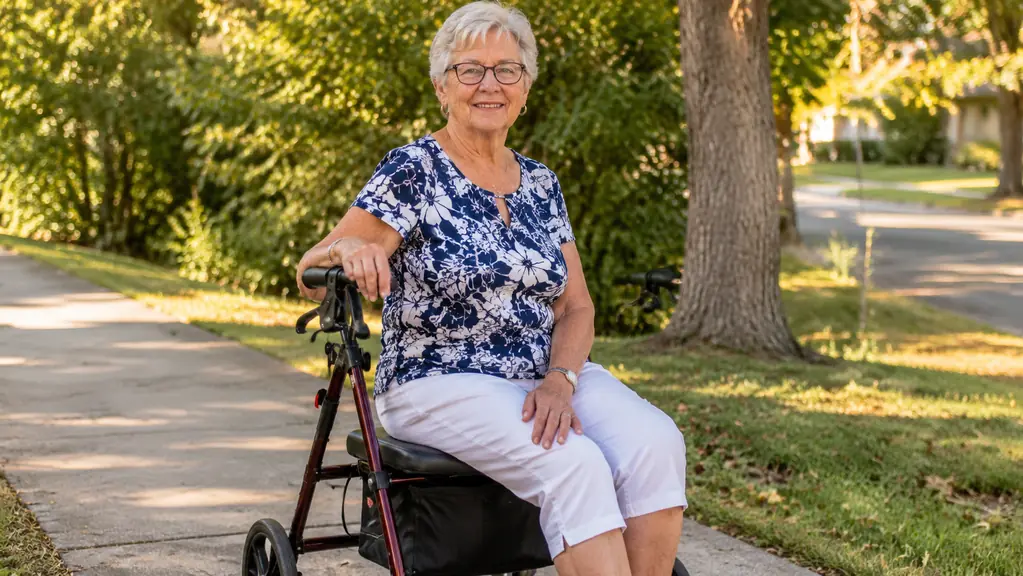
The seat and the fold up removable back support are the two features I would not give up. I know how this sounds. I was 67, I had played rec league softball into my late fifties, and the idea of sitting down on a walk around my own block embarrassed me. Then I did it once, and the rest of the walk was pleasant instead of a countdown.
The rule I would hand you is to sit at the first sign of a wobble in your stride, not at the point of collapse. A wobble is your hip telling you it is doing the work the knee used to do. Two minutes on the seat, back against the back support, both feet flat on the ground, gets you home steady instead of getting you home hurt.
Gene learned it the hard way at the county fair fourteen months ago. He had said no to the rollator for months. Halfway around, his right hip gave out and he sat down on a bench while I went back to the car for it. He has used it on long outings ever since, and he does not apologize for the seat anymore. Neither do I.
Step 5: Get it out of the house and into the car
A rollator that stays in the hallway is doing half its job. Mine lives in the garage, and it goes in the trunk of our sedan for church, the grocery, the fair and the farmers market. This is also where the honest complaint lives: the Drive Medical frame is steel and it weighs 20 pounds, and lifting it into a trunk is real work. I do it in two moves, fold first, then lift with both hands close to my body.
If you are smaller than I am, or if a shoulder is also a problem, have somebody load it the first few times and watch how they do it. Or set it in the back seat instead of the trunk. What matters is that it goes with you. The three steps up to my front door were the last thing to get easy, and they only got there because I was practicing on other steps in other places.
Dana also had me practice the turn at the top of the stairs and the doorway into the bathroom, which is narrower than you would like. Two weeks of being annoyed in a doorway saved me from catching a wheel and going down. Do the boring practice somewhere soft if you can.
What Else Helps
A rollator is not the only thing in our house. Gene carries a HurryCane in his left hand, opposite his weak right hip, and it lives beside his chair. It stands up on its own, which is the only reason he agreed to a cane after a borrowed one slid off a restaurant table onto the floor at our anniversary dinner. I keep a reacher grabber on a hook by the kitchen door for the mail, the coins and the things that roll under the couch. There is a car cane in each of our door pockets for getting out of a parked seat, and a bed bar on Gene's side of the bed.
None of those replace the rollator, and the rollator does not replace them. The cane is for short trips across a parking lot. The car cane is only for getting out of a parked car, and only on the side where it fits. The bed bar is a handle for standing up, not a rail to keep anybody from rolling out of bed, and we do not treat it as one. Match the tool to the distance.
The last thing that helped was not equipment. It was the choir. I sing alto at my church, and standing through a long Sunday rehearsal is how I measure my knee. Four years ago I sat through most of it. Now I stand. I would not have gotten there by walking alone in my hallway, and I would not have gotten there by standing alone either. The walking bought me the standing, and the standing made the walking worth doing.
By month four I was doing the neighborhood loop, about half a mile, with one rest on the seat. The seat is not a failure. It is the reason the half mile was possible.
The one piece of equipment I would buy again tomorrow
Four years, one knee replacement, one county fair rescue and a few thousand laps later, the Drive Medical rollator is still in my garage and still the thing I would hand to anybody starting this. Steel frame, 7.5 inch wheels, fold up removable back support, seat, 350 pound capacity, 20 pounds to lift. Ask your physical therapist about your own situation first. Then set the handles right.
Amazon Check Today's Price on Amazon →